Contents
A Note to the Reader
What sort of author starts a book with a disclaimer? A writer of local history, that’s who. My research for this book has gone oceans wide and fathoms deep—yet I sometimes encountered...
Preface
The water is calm. I dip my paddle rhythmically as a sleek grey seal surfaces just a whisker away from my kayak. I am circling
Ucluelet Harbour, going counter-clockwise, reliving history,...
Chapter 1: What Lies Beneath
Ucluelet sits on the Ucluth Peninsula, within the ḥaḥuułi (Traditional Territory) of the Yuułuʔiłʔatḥ (Ucluelet First Nation). The climate is mild and wet: winter temperatures average at...
Chapter 2: Stewards of the Land
I write this on the Traditional Territory of the Yuułuʔiłʔatḥ (Ucluelet First Nation). The
Indigenous Peoples of the
Northwest Coast have a rich and complex history, fraught with conflict...
Chapter 3: Arrival of the Uninvited
Spanish explorers arrived on the west coast of Vancouver Island in the 1770s, and other Europeans soon followed. European contact had a catastrophic effect on the thriving Indigenous Peoples.The...
Chapter 4: The Fur Trade
Explorers, while seeking adventure and uncharted territory, were always on the lookout for riches. In 1778, when Captain Cook arrived at the village of
Yuquot, Nootka Sound, on the west coast of...
Chapter 5: Of Whales and Whaling
Whales are tied to the spiritual and cultural values of the Nuu-chah-nulth people, who sustainably hunted
ʔiiḥtuup (whales) for thousands of years. Nuu-chah-nulth whaling was done...
Chapter 6: Spreading the Gospel
In Canada, colonialism and religion were hand in hand. Explorers considered it their given right to seize land for their home countries. Missionaries focused on imposing Christianity on the...
Chapter 7: The Names on the Cairn
The early settlers were a hardy and adventurous lot, drawn to the West Coast in a quest for fur, gold, fish, lumber and land. They came from across Canada, the US, Europe and Asia. To survive and...
Chapter 8: More Settlers Arrive
Settlers were drawn to the area by advertisements describing fertile land available for pre-emption. The price seemed too good to pass up—if they followed through on required stipulations...
Chapter 9: This Perilous Coast
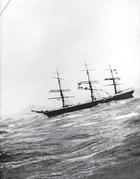
The western shores of Vancouver Island are part of the aptly named Graveyard of the Pacific, which has claimed over two thousand ships.1 Sailors have long approached these waters with...
Chapter 10: Amphitrite Point Lighthouse
A distinctive and unique structure, Amphitrite Point Lighthouse sits, as firmly attached as any barnacle to a rock, in her strategic position at the south end of the Ucluth Peninsula. She has been...
Chapter 11: Life-saving Boats and Coast Guard
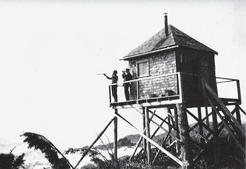
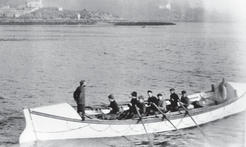
It took a major tragedy to bring lifeboat stations to the west coast of Vancouver Island. For years, the Dominion government and the insurance company Lloyd’s of London had an agreement to...
Chapter 12: Walking the Telegraph Lines
In its early years, Ucluelet was isolated, and communication with the outside world was sporadic at best. With infrequent mail deliveries, a better system was needed. The answer came in the early...
Chapter 13: Boats, Planes and the Long-awaited Road
The first boats used for transportation up and down the coast were dugout canoes, seaworthy vessels carved from single trees. The First Nations were masters at building these canoes and travelled...
Chapter 14: Japanese Canadians of the Coast
Japanese Canadians first came to the west coast of Vancouver Island in the late nineteenth century to work in the whaling industry and to hunt seals and sea otters. As the economic focus shifted to...
Chapter 15: The War Years
When Herbert Hillier shared news of the declaration of World War I over the community phone line, it “stunned the little West Coast community like nothing else ever had.”1 During the war,...
Chapter 16: All That Glitters
In the local resource realm, mining takes a back seat to fishing and logging, but it has its place in the history of Ucluelet and adjacent areas. By 1865 there was lots of hype about gold and...
Chapter 17: The Bounty of the Sea
The Indigenous Peoples of the West Coast have always had a strong connection to the sea and faith in their inherent rights to fish. The nuučaan̓uł traditionally harvested salmon, cod, halibut...
Chapter 18: Logging Heyday and “Nay Day”
When Europeans first arrived on the West Coast, they found forests that had been growing for close to fifteen thousand years, having reclaimed the glacier-scoured landscape.1 The mainly...
Chapter 19: Shopping on the West Coast
Bringing goods to the isolated western coast of Vancouver Island was sometimes a challenge. In the early days, when the sea was the only link with the outside world, “boat days” were eagerly...
Chapter 20: Answering the Call
Charles Mclean was the first medical doctor in the Ucluelet area. He arrived in the early 1900s with his wife, Sarah, and children, settling in a house built for them on the Hitacu reserve....
Chapter 21: Fun and Recreation
Owing in no small part to their isolation, the residents of Ucluelet and area formed a close-knit community. They worked hard, and they created their own opportunities for fun and recreation....
Chapter 22: The Beckoning Beaches
Long Beach and Wreck Bay were sites of early Ucluelet outdoor recreation and picnic outings, a connection that continues today. Early settlers pre-empted land near Long Beach, and the beaches...
Chapter 23: Coastal Creativity
The art of the
nuučaan̓uł (Nuu-chah-nulth) is rich, complex and diverse.The arrival of the uninvited, with their banning of the Potlatch and confiscation of Nuu-chah-nulth cultural...
Chapter 24: Tourism Then and Now
Although Ucluelet and environs have deep resource-based roots, tourism goes back many years. Newspapers in the early twentieth century praised the area’s beauty, often focusing on nearby Long...
Afterword
As a Greek philosopher once observed, there is nothing so constant as change. Here in Ucluelet, we no longer navigate town solely by boat or by boardwalk. From isolated outpost to village to...
Acknowledgements
I am filled with gratitude for the generosity of others. Some beloved elders, gone too soon, gifted me with information and encouragement: Mary Kimoto, Michael Mead-Miller, Vi and Bob Mundy,...
Notes
Chapter 1
1 Margaret Horsfield and Ian Kennedy, Tofino and Clayoquot Sound: A History (Madeira Park, BC: Harbour, 2014), 15.
2 Joanna Streetly, ed., Salt in Our Blood: An Anthology of...
Further Sources
These selections are a sample of the many books, journals and newspapers documenting the history of Vancouver Island’s west coast.
Books
Adachi, Ken. The Enemy That Never Was. Toronto:...
Image credits
p. 13 The reserve at Hitacu, PN03269, Royal BC Museum
p. 15 The Guillod’s house, PN01184, Alberni Valley Museum
p. 18 A potlatch near Hitacu, A-01553, Royal BC Museum
p. 39SS Tees docked at...