
- Home
- Contents
- Maps
- A Note to the Reader
- Preface
- Chapter 1: What Lies Beneath
- Chapter 2: Stewards of the Land
- Chapter 3: Arrival of the Uninvited
- Chapter 4: The Fur Trade
- Chapter 5: Of Whales and Whaling
- Chapter 6: Spreading the Gospel
- Chapter 7: The Names on the Cairn
- Chapter 8: More Settlers Arrive
- Chapter 9: This Perilous Coast
- Chapter 10: Amphitrite Point Lighthouse
- Chapter 11: Life-saving Boats and Coast Guard
- Chapter 12: Walking the Telegraph Lines
- Chapter 13: Boats, Planes and the Long-awaited Road
- Chapter 14: Japanese Canadians of the Coast
- Chapter 15: The War Years
- Chapter 16: All That Glitters
- Chapter 17: The Bounty of the Sea
- Chapter 18: Logging Heyday and “Nay Day”
- Chapter 19: Shopping on the West Coast
- Chapter 20: Answering the Call
- Chapter 21: Fun and Recreation
- Chapter 22: The Beckoning Beaches
- Chapter 23: Coastal Creativity
- Chapter 24: Tourism Then and Now
- Afterword
- Acknowledgements
- Notes
- Further Sources
- Image credits


Chapter 14: Japanese Canadians of the Coast
Japanese Canadians first came to the west coast of Vancouver Island in the late nineteenth century to work in the whaling industry and to hunt seals and sea otters. As the economic focus shifted to fishing, Japanese Canadians went with the trend. They did so with great success, combining a strong work ethic with a heritage of working on the sea.
Japanese Canadians were involved in all facets of local fisheries, including herring and pilchard fishing and processing, and commercial shellfish harvesting. They had a large fleet of salmon trollers and were a key part of the commercial troll fisheries on the West Coast. Many Japanese Canadian fishermen originally settled in the Steveston area to fish the Fraser River. When the government cut back on fisheries there in the early 1920s, many started fishing out of Ucluelet. At first, it was mainly men who came here seasonally, living on their boats. Then the Department of Marine and Fisheries decreed that as of March 1, 1923, only permanent residents would be allowed licences to fish west coast waters. This brought an influx of around fifty Japanese Canadian families to Ucluelet.
Most of the families who settled in and around Ucluelet lived in one of six harbour-side locations. A group of families lived at Hakoda Bay (also called hac̓aaqis and Stuart Bay), situated at the mouth of the harbour, adjacent to Hitacu. Naotsugu Hakoda purchased the property and subdivided it in long, narrow lots so that each of the eleven families would have a section of waterfrontage. The subdivision of the lot was approved on December 18, 1923. Hakoda Bay was an ideal anchorage spot, one where trollers still anchor during fishery openings.
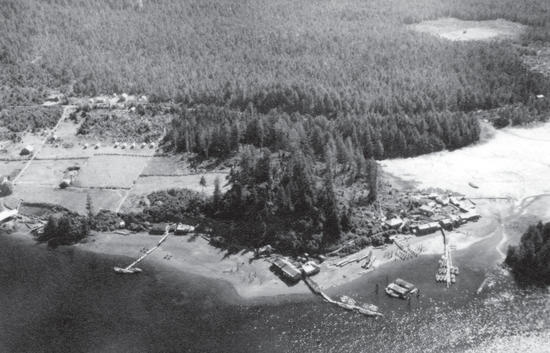
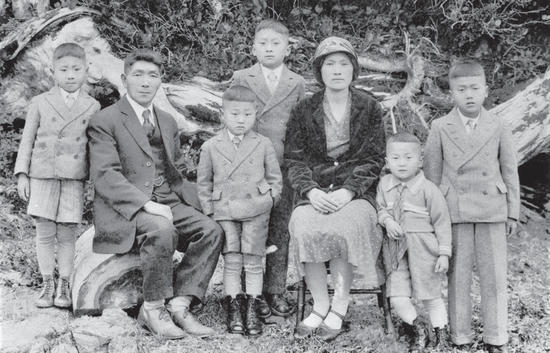
Barbara Touchie grew up close to the Japanese Canadian families at Hakoda Bay and played with the children there. They overcame language barriers by creating their own sign language. When a dead seal was found with a live seal pup, Barbara’s family raised the pup, which the children named Buster. He would go for long swims, returning to the children when called.
Another site on the east side of the harbour was Shimizu Bay, in the Port Albion area, where Kiuroko Shimizu and his brother lived with their families and ran their boat-building business. When Shigeru Nitsui came to Ucluelet in 1921, there were some Japanese Canadian families living in a big bunkhouse on the hill at Port Albion.
On the west side of the harbour, Japanese Canadians had homes at Sunahama Bay (“sandy beach”), next to the dock of the same name, at the entrance to the present boat basin. Some of the houses were built on posts, others on log skids. Because of the mudflats, it was too shallow to moor fishing boats, so the dock often referred to as the Japanese Dock was built in deeper water. The lots here were leased from August Lyche. A Japanese school was built nearby, and the children attended for several hours each afternoon, after going to the main Ucluelet school for the day.
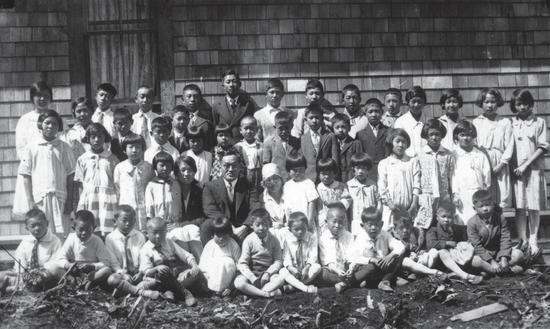
More families lived at Bunji Bay (also referred to as Gunji Bay), near the site of the present-day Eagle’s Nest Pub. This land was also leased from August Lyche. The houses stood on stilts. In a 2015 interview, Harry Hirokazu Hamade spoke of his childhood years at Bunji Bay. He recalled fishing for perch off the family’s porch at high tide and then confining the live catch in the water below their home until it was time to cook it for dinner. Hirokazu also related that when his father, Risuke Hamade, was prohibited from getting a commercial fishing licence by policies limiting licences for Asian people, he asked a nuučaan̓uł man to acquire a licence, and they fished together. Fishing went well, and Risuke bought a larger home in Port Albion. Before the family could move into it, World War II intervened. Henrietta Whipp agreed to rent out the Hamades’ new home for them during internment, but the government seized it, despite Risuke’s strenuous objection.
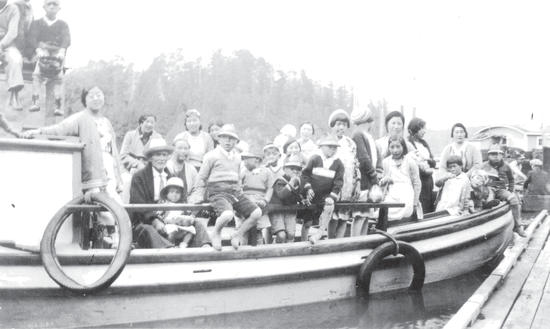
There were more homes at Fraser Bay, below Imperial Lane, adjacent to the present 52 Steps Dock. Most of these homes were also built on stilts out over the water. Some of them still stand, one of them on a lot purchased by Tatsumatsu Oura in around 1920. His son-in-law Tatsuro Oura (whose last name was Hamanishi before he changed it to Oura) inherited the land and built a house on it in about 1940. The new home, completed except for the planned wallpapering, was soon confiscated by the government. Some eighty years later, a new owner was renovating and found a piece of lumber inside a wall, labelled “Oura, Ucluelet.” The Oura house, like others around Fraser Bay, is still in use.
The island directly across the bay from Hitacu and Stuart Bay is now called Hyphocus Island. Harry Toichi Nitsui was able to acquire the island as a pre-emption, because of his military service in World War I. He had three houses on the island, as well as a chicken house, possibly because some sort of farming or ranching industry was expected when land was pre-empted. Toichi lost the island and all the assets during internment, despite a letter he sent to the government declining to relinquish his property.
Spring Cove, where the Kimoto families live, was another site for Japanese Canadian homes and moorage, as well as for two stores, run by Umezo Morishita and Senkichi Nishi, who lived with their families next to the stores. A white settler family, the Saggers, also had a store at Spring Cove. Toshiro Shimizu and his family lived in a home behind the Saggers’ store and house.
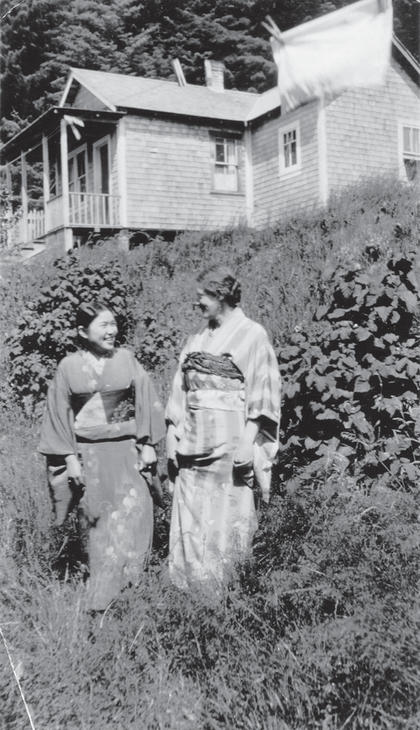
Through the dedication of Mary Toshiko Kimoto, Ellen Kimoto and Claudia Cole, these six sites were officially recognized in 2017 as places of historical significance in Japanese Canadian history, placing Ucluelet on the BC Register of Historic Places.
In Ucluelet, and up and down the coast, Japanese Canadians worked hard and contributed much to their local communities. Then, when Japan bombed Pearl Harbor on December 7, 1941, suspicion was turned on the Japanese Canadian residents of the West Coast. They were Canadian citizens, and many of them were born in Canada, but the government deemed them a risk to Canadian security. Their radios and telephones were taken away to prevent them from trying to communicate with Japanese forces.
Their trollers were confiscated. The Japanese Canadian fishermen had to take their boats into New Westminster to be auctioned off at bargain prices. The owners received either no compensation or a token amount. Bob Kimoto told his daughter Ellen that the “sailor” he had to take with him from Tofino immediately succumbed to seasickness, and he had to “babysit” the fellow all the way to New Westminster. Polly Shimizu recalled the anger and fear she felt as a child when her father was forced to leave Ucluelet with his boat in the wild December seas.1 He later told his family that while holed up in Bamfield to wait out a storm, he was threatened with being shot.
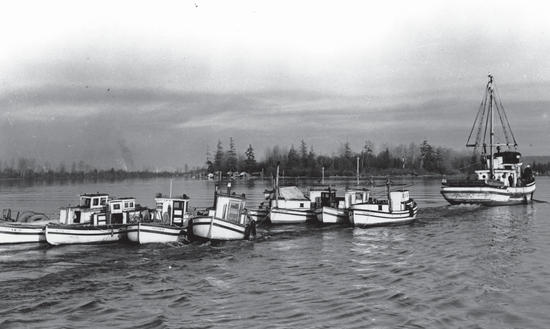
In 1942, the Canadian government implemented a mass evacuation, displacing around twenty-two thousand Japanese Canadians. Those who were on the western coast of Vancouver Island recalled being given forty-eight hours’ notice to leave their homes. They were each allowed to take only what they could carry, which usually amounted to one suitcase or a box of belongings. Some heirlooms were given to neighbours. Other items were hidden, in the hope of eventual return. How does one sort through a lifetime of treasured belongings and choose only the bare minimum?
With so little notice, the Japanese Canadians were forced to depart by boat, leaving their homes, most of their household contents and their beloved pets. Polly Shimizu recalled that as they left the beach in front of their home, their little dog swam after them before finally turning back. It was a long time before she learned that it had survived and been cared for by a neighbour.
Kiyo Harada and Aki Arai, members of the Morishita family, told me their family did not even get to spend that last night in their Spring Cove home. Because of the distance to the main dock, the family quickly gathered up what they could carry and spent the night with friends in town, to avoid being late for the designated 10 a.m. departure. The sisters marvelled at how their mother managed to take her sewing machine, and said it will always have pride of place in a Morishita descendant’s home. Ellen Kimoto’s mother, Isabel Chizuko Kimoto, also took her sewing machine, while struggling to carry her infant daughter and a suitcase of belongings.
Vi Mundy recalled the stories her mother Barb Touchie told of friendships made while growing up next to the Japanese Canadian children of Hakoda Bay. When the families were suddenly forced to leave, it affected Barb deeply, and she never forgot them. Some of the Japanese Canadian residents of Hakoda Bay buried items in their yards. Barb remembered finding fine china dishes in the soil, and other people found bottles of sake.
Later on, when Barb was living in one of the cabins at Hakoda Bay, she heard a tinkling noise while hanging a picture on the wall. Her husband pulled some boards away, revealing a collection of teacups.
D’Arcy Thompson was a young child when he heard the Japanese Canadian women crying as the families made their way from Bunji Bay and Sunahama Bay, along the wooden walkway to the dock, where the Maquinna waited to carry them all away.
D’Arcy also recalled that after their Japanese Canadian friends and neighbours left, their belongings were auctioned off outside the local school. D’Arcy’s father Bud purchased a small bike for him and a scooter for his sister Margaret. Frank Hillier’s mother, Elsie, also wanted to help their Japanese Canadian friends, so she bought a table and chairs. The settlers were told the sale was to provide cash for the Japanese Canadians, but they later wondered if the money ever reached them.
Margaret Thompson recalled how upset her father, Bud Thompson, was when the families were forcibly removed, and how excited and happy he was when his friend Jimmy Nitsui returned to Ucluelet after the war.
Bernard Tugwell, who attended school with the Japanese Canadians kids, was sad to see his friends leave. Bernard told his son Brian, “The day the Japanese Canadian fishing fleet was removed from Ucluelet Harbour was the saddest day in Ucluelet history.”2
Shirley Saggers grew up next to her grandparents’ store at Spring Cove. Their close friends the Shimizu family lived nearby. Shirley’s father, George Sr., told her that when the internment orders came, some officials arrived and put some kind of badge on him, saying, “You work for the government now” and ordering him to help tow some of the Japanese Canadian fleet to Port Alberni. He described it as “the worst day of his life. It was just terrible.”3 The Saggers kept in touch with the Shimizus, who moved to Ontario and came to visit them in Victoria in the 1980s.
These Canadian citizens were now labelled as aliens. Those from Vancouver Island’s west coast were among the first to be interned. Upon reaching Vancouver, they were “housed” in the animal stables on the exhibition grounds at Hastings Park. Conditions were appalling. The women and children were separated from the men. They were allotted horse stalls to sleep in, where they lay on rough straw mattresses in the freezing cold of winter, with the stench of manure in the air. Isabel Kimoto was one of the first to arrive at Hastings Park, with her daughter Ellen just three months of age. Ellen remembered her mother telling her how the exhausted women immediately began cleaning the filthy horse barn as best they could. Eventually, they were given army blankets to hang on each stall for a semblance of privacy. Under such primitive and unsanitary conditions, dysentery broke out and illness was rampant. They lined up outside to receive unpalatable meal rations on tin plates.
The men at Hastings Park were given the choice of going to a different internment camp or working in a road camp. Bob Kimoto and Joe Nakagawa went to work on a road camp in Schreiber, in Northern Ontario. After seven months in Hastings Park, Frances Nakagawa and Isabel Kimoto and children were sent to Slocan in the West Kootenays. Eventually, up to four thousand Japanese Canadians were interned in Slocan. Bob Kimoto and Joe Nakagawa later joined their families there. Although an improvement on the primitive Hastings Park, the environment was harsh. There were few houses, and many of the people spent an unusually cold winter in canvas tents. In the spring, they set about building cabins and planting gardens. Conditions gradually improved.
When schools were set up, the displaced students chose to start each morning with the singing of “O Canada.” The time passed with not only hard work, but a resilient spirit which encouraged the playing of sports such as baseball, and the pursuit of the arts through amateur theatre. With employment forbidden, much time was spent in growing vegetables; Isabel and Bob specialized in tomatoes and pine mushrooms.
Shirley Yaeko Oye had spent her early years in Steveston. Her father died when she was a little girl, leaving her mother to raise nine children, two of whom passed away at a young age. When internment happened, Shirley’s eldest sister and husband were in a Vancouver hospital, recovering from severe illness caused by contaminated fish roe. Shirley’s family was moved to Cordova Street and remained there until the couple recovered. They were among the last people to be sent to the Interior. When they arrived in Popoff, an internment camp near Slocan, in October, it was very cold. Many people were living in tents. Shirley said she and her mother and siblings were lucky to be housed in a bunkhouse. “It was okay,” she told me, although further discussion revealed that the wind had whistled through gaps in the wooden slatted walls, and it had been a constant struggle to stay warm through the fall and winter. Three times daily they went to the mess hall with their tin plates for meals. Again, Shirley described the food as “okay,” although it was not the fresh and appealing food they were accustomed to.4
Mary Kimoto, like Shirley Oye, lived in the Lower Mainland of BC before internment. While Shirley lived in Steveston, Mary lived in Vancouver’s East End . Her parents ran a confectionery store on the corner of Powell and Victoria streets, in an area that came to be known as “Japantown.” The family lived in the back half of the building. Mary’s father died when she was fourteen, so she quit school and went to work to help support the family. Nootka Cannery was hiring, so her mother lied about Mary’s age and sent her off on the Maquinna with a group of girls. She was the youngest of the group and was treated well. Mary was one of only five girls who didn’t get seasick on their trip up the coast.
The work was seasonal. Mary and her siblings also helped their mother run the confectionery store. When word circulated about an upcoming relocation from the coast, Mary’s mother was worried the family might be separated, so she acted quickly. She hired two friends with trucks, who helped load the contents of the store. “My mother said all of a sudden we have to go. We just had to go.” She continued: “We pulled out at about 2 a.m. in the morning and we headed for Kelowna…Of course, that was in January, so we hit snow and it was a scary trip.”5 Mary added they were all worried the RCMP would stop them en route, “but, no, we were lucky, because we travelled in the middle of the night.”6
They reached Kelowna safely, settling into little shacks. There, they worked in orchards and at a greenhouse, growing tomatoes. Their mother climbed ladders to pick fruit, and Mary and her sister collected apples from the ground. Despite the cold weather and new environment, “we just seemed to manage,” Mary stated. “It was something that we felt that we had to do.” She added: “Everything was work, work, work. No time for pleasure. We were old enough to understand the circumstances.”7
Mary had met Tommy Kimoto at a fish plant. They married in August 1944 and moved to Ontario, where Tommy’s sister lived. Mary was not happy at having to leave her mother and siblings, but accepted it with the attitude of shō ga nai. This Japanese term describes situations where something is out of one’s control, so one accepts it and moves on because, as Mary stated, “It can’t be helped.”8
In Toronto, they had no place to stay and so were assigned “domestic” work. Members of the well-known Seagram distillery family soon hired them, Tommy as a butler and Mary as a maid. When asked to also be the cook, Mary said she couldn’t even boil an egg; her employer taught her how to cook.
When the war ended in 1945 with the atomic bombing of Hiroshima and Nagasaki, Japanese Canadians were eventually given the choice of moving to Japan or relocating east of the Rockies. Robert and Isabel moved to Hamilton. Joe and Frances also moved to Ontario, settling close to Sudbury. Finally, in 1949, the BC government allowed Japanese Canadians to return to the coast. The Japanese Canadians were known as excellent fishermen, and BC Packers suggested that some of them return.
Tommy Kimoto flew out from Ontario, decided it would be a good move, and encouraged others to do the same. Many of the relocated Japanese Canadians, understandably disillusioned with the BC government, would not come back. However, Tommy convinced a core group of ten Japanese Canadians to come out to the coast. Tommy was interested in a troller being built at Brentwood, bought it with financing assistance from BC Packers, and was ready to resume fishing.
Mary recalled that Tommy was eager to get back to the coast from Ontario: the couple and their two young sons left Toronto in a newly-purchased Pontiac, detouring down through Montana because of snow in Manitoba. They then veered back up to drive through the Rockies. “Tom got so excited when he saw those mountains,” Mary recounted. “We were almost home.”9
Tommy wanted to return to Clayoquot Island, near Tofino, his home since the early 1920s. Tofino did not welcome him home. There had been a discriminatory motion of exclusion called “The Resolution Regarding Orientals” presented at a meeting in Tofino on January 24, 1947. It stated: “The Commissioners of the Corporation of the Village of Tofino hereby resolve—That, at the request of the residents of the Village of Tofino, all Orientals be excluded completely from this Municipality, and shall be prevented from owning property or carrying on business directly or indirectly within the Municipality.”10 Although the resolution was never officially adopted, the sentiment was known. The Japanese Canadians did not feel welcome. Tommy and Mary moved to Ucluelet and encouraged others to do the same. Tofino’s loss was truly Ucluelet’s gain.
“They were fishermen, so they came back,” said Ellen Kimoto. “They got boats and they were on the sea and they just started all over again.”11 When the group of ten fishermen first arrived, they lived aboard their boats, tied up at my uncle Art Baird’s dock. The men purchased land and homes, and their wives and families soon joined them.
Tommy and Mary settled in Spring Cove, and were soon joined by Bob and Isabel Kimoto, Joe and Frances Nakagawa, and other families. Spring Cove is a beautiful and idyllic spot, but when the families arrived in the early 1950s, there were few amenities. “When we got here, goodness, there was no water, no electricity,” Mary said. “It changed my whole lifestyle.”12 The women drew water from a shared well and did their laundry among the rocks down by the beach. With no road to nearby Ucluelet, regular trips to town were either by boat or along a wooden walkway and trail. This was the route for the kids to and from school, and for the moms to and from work as well as the meetings of the many village groups they volunteered with, such as the PTA, the Ucluelet Recreation Commission and the Ucluelet Swim Club.
Joe and Frances Nakagawa, like Tommy Kimoto, had lived in Tofino before internment. They settled at Spring Cove in 1952 and raised ten children there. Frances recalled the kids trying to do their homework in the dim lighting, as there was no electricity. “Eight loaves of bread in the wood stove and my husband was just busy, always busy…fishing, chopping wood, and more.”13 Wood was plentiful—she described their place as like a sawmill, with lots of logs coming in on the tide. Frances said that raising those kids and keeping things going, providing meals, heating the house, was a full-time job.
Spring Cove had been used during the war as a base for the forces. Tommy, Mary and family first lived in a portion of what had been the recreation hall. Bob, Isabel and family moved into the former first-aid building. In 1982, Isabel’s new home was built, and the first-aid building was torn down. Suzy and George Kimoto lived close to the beach, in what was once an officer’s house.
Shirley Oye moved to Ucluelet in around 1953, when her husband Shiro decided to leave logging and join his family in the fishing industry on the west coast. Shirley initially did not want to leave her family in the Lower Mainland, and was not impressed with Ucluelet upon arrival, but said she was lucky to have married a good, hard-working man like Shiro. When they moved into a house built on pilings over the harbour, Shirley was constantly on edge about ensuring their three young boys didn’t fall into the water. At first, they struggled to pay their fifteen-dollar monthly rent. Shiro quickly became a successful fisherman.
As a young teenager, Shirley had worked at a tomato cannery in Kamloops to send money back to help support her mother. Despite years of hard work and the hardships of internment, Shirley maintained a positive attitude. She was consistently supportive of others. I will always appreciate the encouragement she gave my mother after my father died and Mom moved down the road to a smaller house she had built next door to Shirley and Shiro.
The Japanese Canadians, exhibiting no bitterness for their harsh treatment during the war years, quickly became an integral part of the community, contributing time and energy through volunteerism.
Japanese culture figures strongly in the heritage of Ucluelet. One huge contribution made by the Japanese Canadian women is culinary: any big social event in Ucluelet almost always features mouth-watering Japanese delicacies, such as octopus salad and fishcakes. At weddings, funerals, New Year’s celebrations or extravaganzas put on for visiting dignitaries, the feasts provided by the Japanese Canadian ladies have always been highly prized.
The ultimate feast presented by the ladies was at the Fishermen’s Ball, where members of local fishing families dressed to the nines, drank, partied, danced up a storm and feasted on the bounties of the sea. The first Fishermen’s Ball took place in 1961. Mary Kimoto recalled that as years went by the event got bigger and bigger, until they were making enough food for 265 people or more. (Patsy Tyne’s seafood chowder was another culinary success year after year.)
I was born in 1951, postwar and post-internment. For me, the Japanese community has always been integral to Ucluelet, true “locals.” When I finally found out about the internment, and how some members of our community had been treated during and after the war, I was shocked and saddened.
The survivors of the internment moved forward with dignity, resilience and a strong work ethic. The Japanese Canadians retained their culture, which is interwoven through the fabric of West Coast heritage. Some of the families who settled here and contributed so much are the Kimotos, Nakagawas, Oyes, Nitsuis, Mayedes, Nasus, Hamanishis, Kariyas, Ouras, Suzukis and Nakatsus. A large number of families did not come back after the war and internment, and that was a huge loss to the community of Ucluelet.
On October 7, 1992, over fifty Japanese Canadians came to Ucluelet to commemorate the fiftieth anniversary of the internment and to “celebrate their survival in the face of great odds.”14 Mary Kimoto hosted the evening event at the Ucluelet Secondary School Band Room. She continued, with grace and tenacity, to advocate for the preservation of local Japanese Canadian history right up to her hundredth birthday. The Ucluelet and Area Historical Society board continues to regard her as its inspiration and matriarch.
Redress
After World War II, Japanese Canadians organized the Japanese Canadian Committee for Democracy, which later became the NAJC—the National Association of Japanese Canadians. A redress movement began and grew, and finally the federal government responded. There was a redress settlement in September 1988, in which each Japanese Canadian citizen who had survived internment, or who had been born before April 1, 1949, was awarded $21,000. At the same time, then prime minister Brian Mulroney gave a formal apology on behalf of the federal government.
It did not by any means settle the harsh and complicated legacy of internment, and more attention was given to redress.
Ellen Kimoto of Ucluelet was involved in a federally funded research project called Landscapes of Injustice, launched in 2014 and headed by the University of Victoria. One of its initiatives was to investigate what happened to the properties, the assets and all that the Japanese Canadians had been forced to leave behind.
Despite an apology at a national level, regional sores still festered. On the western coast of Vancouver Island, Tofino’s 1947 resolution of exclusion was well known. In 1997, at the request of Mr. Sado Sato, who had purchased property in Tofino, the resolution was rescinded by Tofino Council. At that time, council stated there was no record of the 1947 resolution ever being voted on or passed, but they wanted to make it clear “that the District of Tofino rejects any exclusionary policy based on racial or ethnic origin.” Then, on May 28, 2019, the mayor of Tofino, Josie Osborne, gave a heartfelt apology for the 1947 motion, on behalf of the town’s council.
Tommy Kimoto, who had not been welcomed when he tried to return to Tofino after World War II, did not hear the apology; his widow Mary and his son Doug did. Afterwards, Mary said, “It’s finally happened and I’m just speechless.”15 Doug, who came to Ucluelet with his parents and brother Gordie in 1951, at the age of ten months, added: “This is an apology for all the families that lived here years ago and reconciliation for the Japanese Community.”16 Doug described the apology as righting a long-standing wrong, and acknowledged that “it took a lot of will to do this” on the part of the proactive mayor and council.
Ellen Kimoto described the mayor’s apology as “heartfelt and emotional,” but said the event was bittersweet—“The bitter part was that the people who really suffered weren’t there to hear it…My mom and all her age group; they’re all gone.”17
Acknowledgement of Internment and Japanese Canadian Legacies in BC
On May 21, 2022, BC’s premier, John Horgan, made an official announcement regarding redress. Citing the “irreparable social, economic, and psychological harm” suffered by Japanese Canadians at the hands of the BC government, and affirming that “this is not a proud history,” Premier Horgan announced a government contribution to “support the legacy initiatives recommended by the National Association of Japanese Canadians, in conjunction with Japanese Canadian communities in BC.”
The six initiatives were: Monument; Education; Senior Health and Wellness; Community and Culture; Heritage Restoration; and Anti-racism.
A group of locals gathered in the Ucluelet Community Centre to witness the event live-streamed from Steveston. Three internment survivors—Mary Kimoto, Ellen Kimoto and Suzie Corlazzoli—were there, as well as descendants of others who had been interned. MLA Josie Osborne was on hand to represent the BC government. Paul Kariya, who grew up in Ucluelet, played an important role in the achievement of the redress.
In 2024, the Ucluelet and Area Historical Society received funding from the Japanese Canadian Legacies Society for the creation of a permanent open-air pavilion to present local Japanese Canadian history and to honour the significant contributions of the Japanese Canadian community to Ucluelet and the surrounding area. The pavilion will overlook the historic site of Fraser Bay.