
- Home
- Contents
- Maps
- A Note to the Reader
- Preface
- Chapter 1: What Lies Beneath
- Chapter 2: Stewards of the Land
- Chapter 3: Arrival of the Uninvited
- Chapter 4: The Fur Trade
- Chapter 5: Of Whales and Whaling
- Chapter 6: Spreading the Gospel
- Chapter 7: The Names on the Cairn
- Chapter 8: More Settlers Arrive
- Chapter 9: This Perilous Coast
- Chapter 10: Amphitrite Point Lighthouse
- Chapter 11: Life-saving Boats and Coast Guard
- Chapter 12: Walking the Telegraph Lines
- Chapter 13: Boats, Planes and the Long-awaited Road
- Chapter 14: Japanese Canadians of the Coast
- Chapter 15: The War Years
- Chapter 16: All That Glitters
- Chapter 17: The Bounty of the Sea
- Chapter 18: Logging Heyday and “Nay Day”
- Chapter 19: Shopping on the West Coast
- Chapter 20: Answering the Call
- Chapter 21: Fun and Recreation
- Chapter 22: The Beckoning Beaches
- Chapter 23: Coastal Creativity
- Chapter 24: Tourism Then and Now
- Afterword
- Acknowledgements
- Notes
- Further Sources
- Image credits


Chapter 1: What Lies Beneath
Ucluelet sits on the Ucluth Peninsula, within the ḥaḥuułi (Traditional Territory) of the Yuułuʔiłʔatḥ (Ucluelet First Nation). The climate is mild and wet: winter temperatures average at
9°C, summers at 17°C. Average yearly rainfall is 3,420 millimetres. Vegetation thrives in this temperate rainforest, and we are surrounded by myriad tree species, including cedar, spruce and hemlock.
Ucluelet’s vistas include rocky outcroppings, hidden coves and pebbled beaches facing the open Pacific, and a protected inner harbour featuring islands, more beaches and mud flats. Across the harbour from Ucluelet sit the communities of hitac̓u and Port Albion. Above them tower č̓umaat̓a (Mount Ozzard) and Mount Frederick. Ucluelet Harbour is open to the western edge of Barkley Sound and its archipelago of over one hundred islands.
I grew up free to explore both sides of the Ucluth Peninsula. My dad’s only words of warning were: “Always respect the ocean. Never turn your back on her.” I spent countless hours rowing the not-always-calm waters of Ucluelet’s “safe harbour,” combing the beaches and rock-scrabbling the rugged outer shoreline. I loved it all, but never reflected on what forged the landscape of this place I call home.
Earthquakes and Tsunamis
Vancouver Island is near the northern end of the Cascadia Subduction Zone, where the lower, denser, oceanic Juan de Fuca tectonic plate grinds against the North American continental plate. The Juan de Fuca plate slides eastward at a pace of 2.5 to 5 centimetres per year. The North American plate moves westward. When the two become locked, immense pressure builds. The only release is a massive megathrust earthquake.
In the past ten thousand years there have been thirty-nine megathrust earthquakes along the Cascadia fault, nineteen of them between 8.7 and 9.2 on the Richter scale. Time span between megathrust earthquakes ranges from eight hundred to two hundred years.1
The most recent was on January 26, 1700. First Nations Oral History tells of a massive tidal wave five or six metres high. A Yuułuʔiłʔatḥ story tells of a dugout canoe being found far up on č̓umaat̓a, the seven-hundred-metre mountain inland from their main village on Ucluelet Inlet. The entire Huu-ay-aht village at Pachena Bay just south of Barkley Sound was engulfed, then swept out to sea. There were no survivors. That earthquake sent a tsunami across the Pacific. The five-metre wave hit Japan ten to twelve hours after the quake, causing widespread destruction. Thousands of people died.
March 27, 1964, was not a Good Friday for those affected by the megathrust earthquake that struck near Anchorage, Alaska, more than two thousand kilometres up the coast from Ucluelet, as the crow flies. At 9.2 on the Richter scale, it was the largest earthquake ever recorded in North America. It happened at a depth of approximately twenty-five kilometres and lasted four minutes and thirty-eight seconds. In the earthquake and resultant tsunami, 131 people died.
Tsunamis occur when a tectonic plate shifts and the ocean displaces suddenly to fill the void. The 1964 Alaskan megathrust earthquake forced the ocean floor fifteen metres upward, setting off a tsunami that raced southward down the coast and west across the Pacific at speeds between 640 and 830 kilometres per hour. In less than five hours, it reached Vancouver Island’s west coast.
The tsunami hit the small Hesquiaht First Nation village of Hot Springs Cove hard. Many homes were damaged. Some caught fire when waves toppled lanterns. Community members rode out the waves aboard their boats, returning to find just two of eighteen homes still standing. The new Roman Catholic Church sat fifteen metres from its base. Thankfully, no lives were lost. The community rebuilt in a safer location.
At the time, Neil Buckle lived facing the open Pacific, north of Ucluelet at Combers Beach. Home after visiting his wife, Marilyn, and their newborn son at Tofino Hospital, he was awakened by a loud roar. He recalled saying, “Oh for Christ’s sake, it’s a tidal wave!” and later described it as “absolutely mesmerizing.”2Neil saw his Dodge truck afloat, and “huge logs…tossed like match sticks…I was totally stunned.”3
Because the harbour entrance sat at an angle to the wave’s trajectory, Ucluelet got off relatively lightly. Many fishermen, alerted about the impending wave, took their boats out to sea. The first surge arrived close to midnight, smashing pilings and tearing out two Department of Transport floats at Spring Cove. At the BC Packers shore plant, eight floats and a gangway broke loose. John Walton’s ten-metre troller sank by its berth at BC Packers and was a writeoff. Fishermen worked through the night to salvage the floats. They retrieved seven. The other three were presumed swept out to sea.
At the head of Ucluelet’s harbour, a log boom containing five million board feet of timber broke up. Some of the logs crashed into pilings, damaging wharves. Amazingly, most of the boom was recovered, largely intact.
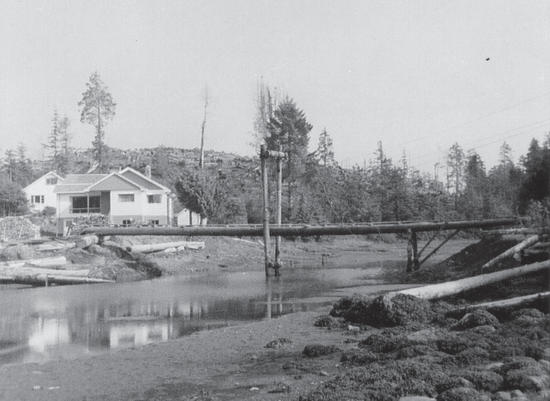
The pipe transporting the community’s water supply under Ucluelet Inlet ripped apart in several places. Divers Jimmy Hill and Lew Klock worked for two days to repair the breaks. The tidal surge also broke the telephone and TV cables under the inlet and shifted the power cable. Hydro lines between Ucluelet and Port Alberni failed.
Commercial fisherman Axel Tomren and his wife, Pat, were hosting a party at their home on Tomren’s Island (Hyphocus Island) that evening when some kids rushed in, shouting, “The water is coming up really fast!” Some guests left in a hurry, eager to get off the island across the pedestrian-only log bridge. Dorothy Larsen and her husband, Albert, were at the party. When Axel warned that the log bridge might soon float away, Dorothy headed home to her kids. Several other ladies joined her, and they sat in the dark.
Just up the coast, Tofino, like Ucluelet, got off lightly despite some damage, including disrupted floats and a broken municipal waterline. Alberni and Port Alberni did not fare so well. The twin cities (now amalgamated into Port Alberni) sit at the head of a long, narrow inlet stretching forty kilometres inland from Barkley Sound. As the wave sped through the canal, it compressed, increasing in height and speed. The first wave hit just after midnight. A second wave, towering nearly five metres, slammed the Albernis an hour later. Several more waves followed at ninety-minute intervals. The onslaught washed away 65 houses and damaged over 375 others. Vehicles were tossed around like dinky toys. The Albernis suffered over $5 million damage. Incredibly, no lives were lost.4
Ethel King, a British war bride, rode out the waves with her two children and cats in the attic of “their bobbing, spinning house.”5 Ethel peered through the attic window as their propane tank floated by. “It was hissing and I was sure it was going to explode. An hour later we passed it again and it was still hissing.”6 The house floated around for three hours before settling in a field.
Life on the Edge
We reside on a tectonic belt circling the Pacific Ocean, a “ring of fire” where most of Earth’s volcanoes and earthquakes occur. As science and technology progress, we become better informed about these cataclysmic events. As a child, I was oblivious to the possibility of the “Big One”—now I am only too well versed in the potential danger. It’s not unusual for us to feel occasional small earthquakes. But there was one memorable night, some time in the early 1990s, that stands out in my memory.
Light-Headed
It was almost midnight, and I couldn’t sleep. I turned on the bedside lamp and stared up at the ceiling.
“What’s the matter?” my husband asked, rolling over in bed.
“If there’s an earthquake, that light fixture will fall right on my head.”
“It’ll be fine,” he answered. “Go back to sleep.”
“Easy for you to say,” I replied. “It’s not above your head!”
To appease me, he climbed out of bed, lifted the heavy glass lampshade from its hanging frame and placed it on the floor, saying, “There. Now go to sleep!”
At 4 a.m. the house shuddered with a sudden jolt. I was already awake, having just gone to the washroom.
Keith sprang out of bed. “Did you feel that?”
There had been an earthquake out in Barkley Sound.
“It probably wouldn’t have made the light fixture fall,” he said.
“We’ll never know,” I answered.
The next time we went out of town, we bought a fabric lampshade to replace the heavy glass one.
That earthquake in Barkley Sound was a small one, large enough to feel, but not the type to create a tsunami. But for those of us living here on “the edge,” there is a niggling awareness that tectonic plates are moving deep on the ocean floor, and that as pressure builds, another “Big One” could occur offshore.
We have had occasional alerts and warnings over the years, enough to keep us on our toes. The waves mainly fizzled out, becoming barely detectable.
“Why Are You Still Home?!?”
One Tuesday evening, I got a call from my friend Judith. “I’m surprised you’re still home!” she said.
It turned out there’d been a tsunami alert, and her husband had phoned her from his fishboat off Haida Gwaii to warn her. And she thought that since my husband was the fire chief, I might have more information.
Not so!
It was regular Tuesday-night fire practice. I called the hall and asked to speak to the chief. “I don’t know,” said the brigade member. “He’s pretty busy. We’ve had a tsunami alert.”
When I got to talk to my hubby, I asked when he was going to let me (and our golden retriever) know about the situation.
“No worries,” he said. “I’ll call you if you need to move to higher ground.”
Although reassured, I asked him if he had a life insurance policy on me that I didn’t know about.
Jocularity aside, the threat exists. I, like many west coasters, live below the tsunami safe zone. Although I like to say I’ll ride the big wave in my kayak, I still believe in being prepared. We have grab-and-go kits ready. With a tsunami warning, we have time to load up the car and drive to the high school, one of six designated safe zones. If a megathrust occurs, we will have approximately twenty minutes to reach high ground before the first tsunami hits. Our plan is to head across the street once the shaking stops, and dash up my cousin’s steep driveway to high ground.
We appreciate monthly practice alerts provided through phone calls, texts and tsunami sirens. Ucluelet has well-trained fire-rescue personnel and emergency services .
Buoy Oh Buoy!
On November 17, 2020, a record-breaking wave the height of a four-storey building was detected six kilometres offshore of Ucluelet. This wall of water was measured by an offshore sensor buoy, one of twenty-six placed along North America’s coastline by MarineLabs Data Systems. University of Victoria oceanographer Johannes Gemmrich assessed the probability of a wave like this occurring as once every thirteen hundred years.7 Such waves appear in the open ocean, usually with no warning or causal explanation. The first scientifically measured rogue wave, the “Draupner wave,” was detected in 1995 off Norway. At twenty-five metres in height, the Draupner wave was taller than the Ucluelet wave, but just double the height of nearby waves. The seventeen-metre wave off Ucluelet broke records because it was three times taller than surrounding waves.
Rogue waves are also called freak waves, killer waves or monster waves. Scientists label them extreme storm waves. Although there was no damage reported from the Ucluelet offshore wave, they can be extremely dangerous, threatening ships, structures and people. (I am again reminded of my father’s warning to never turn my back on the ocean.)
Owing to the rarity of rogue waves, scientists still work to determine their cause. One theory suggests that with increasingly extreme weather patterns caused by climate change, rogue waves might become more intense and frequent. Earthquakes, tsunamis and rogue waves all add to the uncertainty of life here on the West Coast. Meanwhile, my mantra is “Be prepared, then don’t dwell on it” as life on the edge goes on.