
- Home
- Contents
- Maps
- A Note to the Reader
- Preface
- Chapter 1: What Lies Beneath
- Chapter 2: Stewards of the Land
- Chapter 3: Arrival of the Uninvited
- Chapter 4: The Fur Trade
- Chapter 5: Of Whales and Whaling
- Chapter 6: Spreading the Gospel
- Chapter 7: The Names on the Cairn
- Chapter 8: More Settlers Arrive
- Chapter 9: This Perilous Coast
- Chapter 10: Amphitrite Point Lighthouse
- Chapter 11: Life-saving Boats and Coast Guard
- Chapter 12: Walking the Telegraph Lines
- Chapter 13: Boats, Planes and the Long-awaited Road
- Chapter 14: Japanese Canadians of the Coast
- Chapter 15: The War Years
- Chapter 16: All That Glitters
- Chapter 17: The Bounty of the Sea
- Chapter 18: Logging Heyday and “Nay Day”
- Chapter 19: Shopping on the West Coast
- Chapter 20: Answering the Call
- Chapter 21: Fun and Recreation
- Chapter 22: The Beckoning Beaches
- Chapter 23: Coastal Creativity
- Chapter 24: Tourism Then and Now
- Afterword
- Acknowledgements
- Notes
- Further Sources
- Image credits


Chapter 15: The War Years
When Herbert Hillier shared news of the declaration of World War I over the community phone line, it “stunned the little West Coast community like nothing else ever had.”1 During the war, Hillier received a news bulletin every night and updated the locals by emergency telephone ring.
On the home front, locals pitched in for the war effort. Women gathered over pots of tea, Red Cross emblems on their sleeves, cutting and packaging bandages, and knitting mufflers, mitts and socks for what Phyllis Binns described as “the soldier’s poor blistered feet.”2
George Fraser gave up using butter, sugar and other articles, donating what he would have spent on them to the Red Cross. He also sent yearly shipments of heather to Victoria “to be sold for the benefit of patriotic funds.”3 In 1918 alone, “Heather Day” netted “the handsome sum of $1,131.30.”4
Every bit helped. In 1914, a dance in Ucluelet yielded $12 to be forwarded to the Patriotic Fund. In March 1917, $68.55 was raised for the cause at a concert at the school at Hitacu. In 1918, a dance at the Ucluelet East school raised $15.50, and the affair ended with the singing of the national anthem and “three cheers for the boys at the front, and the ladies of Ucluelet.”5
As well as participating in fundraising, many nuučaan̓uł citizens expressed an interest in enlisting. Indian agent Gus Cox reported that “the leading men of a number of west coast tribes, at present in Victoria, have expressed their desire to be allowed to serve…and offer to send numbers of their younger men if called upon.”6 Over four thousand Indigenous soldiers fought in World War I, but because of incomplete records it’s hard to document a number specific to Vancouver Island’s west coast.
The Men Who Went to War
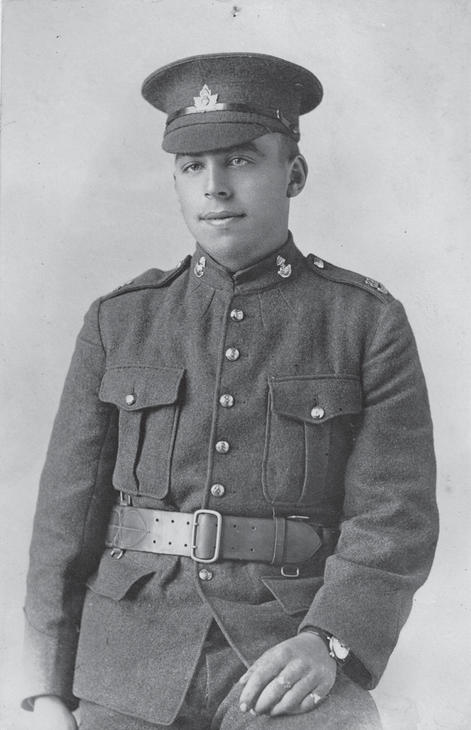
William Hillier went overseas in June 1916 to serve as a private in the 88th Battalion (Victoria Fusiliers) CEF. He was wounded at the Battle of Vimy Ridge in April 1917, and spent several months in a London hospital. He then returned to duty, guarding German prisoners of war in Seaford, England, and then travelled home to Ucluelet at war’s end. William received a medal for his service.
William’s pay during World War I was one dollar per day, plus an additional ten cents a day when on the battlefield. Despite this meagre amount, he saved enough money to buy a piano for his mother when he got home.
The Daily Colonist of December 2, 1915, reported that William Thompson, formerly in charge of the power lifeboat stationed at Ucluelet, was serving on a British submarine in the North Sea, as a lieutenant in the Royal Navy Volunteer Reserve. The newspaper article shared an excerpt from a letter from Thompson to Gordon Halkett:
"I have visited the famous lifeboat stations and met the superintendent, who is going to show me the rocket apparatus, etc. The Gorleston boat is 44′ × 12.6′ beam, sail propelled—carries oars as well—and has been in use for 22 years. Of course, this proposition is entirely different to ours—stations dotted close together along the coast and all sandbanks and beaches.
I would like to see similar craft bumping ashore on Wreck Bay or Long Beach in a gale. There wouldn’t be much of the boat left. I trust all is well at the Ucluelet station. The war is frightful, the end nowhere in sight I fear, but, of course, the only one end is possible. When that comes I shall make a beeline for the West Coast.
"
In another letter, Thompson mentioned that William Maitland-Dougall and Lieutenant Brown were stationed on submarines nearby, “so poor old Ucluelet hasn’t done so bad.” He added: “I can assure you the navigation of the North Sea these times is no joke.”7 Unfortunately, William Maitland-Dougall became a casualty of war.
Thompson was the first Royal Navy Volunteer Reserve officer to serve in British submarines, and the first Canadian to do so.8 Known as “Whiskers” Thompson by his fellow servicemen, he made quite an impression. The following excerpt is from a ditty published in the March 1916 issue of Maidstone Magazine, a newsletter published by the 8th Submarine Flotilla based in Harwich.
"Tarrybreeks by The Alecto Poet
Of Tarrybreeks a lay I’ll sing
"
Euchulet’s famous Lumber King,
Who there, remote from worldly strife
For years endured the simple life…
Old Tarry felt a trifle slow
No picture palace could it show.
So he forsook that peaceful scene
And hied him to a Submarine
And felt how grand it was to be
A terror both by land and sea…
He’s up to any mortal thing
This unrepentant Lumber King,
Throughout the world where’er one seeks
Non can compare with Tarrybreeks.9
When Wilfred Thornton enlisted for service on February 19, 1917, records showed his place of residence as “Weuelet,” British Columbia. After the war, Wilfred returned to his wife and young son at home in Ucluelet, and later had another son. Both children would serve in World War II.
Toichi Nitsui, a Ucluelet fisherman who owned Hyphocus Island, served in World War I and returned safely. Despite his years of patriotic service, Toichi was interned in south-central BC during World War II. His property, including the fifty-two-acre island, was confiscated and sold, and his letters to the government protesting this unfair treatment were dismissed.
Ed Homewood of Ucluelet enlisted with the 50th Regiment (Gordon Highlanders) in 1914 and went to the front with the 16th Battalion. A newspaper article describes injuries he sustained at the Battle of Festubert: “After army surgeons got through picking splinters of bone from his brain there was a place on the top of his head, covered only by skin and hair, as big as the palm of his hand. For many years Ed wore a saucer-shaped metal plate under his hat, but as the years went by the bone grew in from the sides until now the hole is about as large as a silver dollar.”10
The brain surgery left Ed with a partially paralyzed leg, but he returned to the coast and lived a full and active life. In 1960, Ed and his wife, Esther, visited one of the surgeons in England. When asked if Sir Claude Franklin had been surprised to see him, Ed replied: “He was astonished. He told me I should have been dead! But I sure fooled him.”11
Norman Lyche, son of Ucluelet settlers August and Alice Lyche, signed on with the 136th University Battalion, arriving in England in 1916. He later transferred to the Canadian Engineers, serving in France as a lieutenant. Norman returned safely from the war, but drowned at the age of thirty-two after falling overboard from his fishboat. When a fish packer exited the harbour carrying his body in a flower-covered coffin, local war veterans stood at attention on the wharf. Twenty boats accompanied the packer to the mouth of the harbour. Norman Lyche was interred in the Ross Bay Cemetery, Victoria, with full military honours.
Carl Binns was keen to enlist, wanting to be “in the thick of the fray.”12 When he was rejected because of problems with his feet, his complaints were constant, until his wife, Ethel, finally told him that the way he was carrying on about it, she wished he would go! Carl found some solace in being a lifeboat crew member on the lookout for enemy submarines.
William Karn, like Carl, was rejected for health reasons, despite his eagerness to serve. William even lied about his age and dyed his hair to look younger. He was turned down because of severe varicose veins, which the authorities said would interfere with marching. This angered William, especially after all the “marching” he had done back and forth to his pre-emption property over the years.13 William helped the war effort by working in a munitions factory.
Bert Hillier also tried to join up. He was around fourteen years old at the time. Bert headed off to Port Alberni in the family canoe, a good eighty kilometres across Barkley Sound and down Alberni Canal. There, the recruiting officer recognized him as William Hillier’s younger brother, told Bert he was too young, and sent him off home to Ucluelet.
Hamish Maitland-Dougall was the son of James and Winnifred Maitland-Dougall, who were from Duncan but sometimes lived in Ucluelet. When Hamish enlisted, he was a Ucluelet resident. A corporal in the Canadian Infantry (Central Ontario Regiment), 102nd Battalion, Hamish died at the age of twenty on April 9, 1917, during the storming of Vimy Ridge. His name is listed on the Canadian National Vimy Memorial as one of over eleven thousand Canadians soldiers missing and presumed dead.
Less than a year later, on March 15, 1918, the Maitland-Dougalls lost their eldest son William to the same war. He was the only Canadian submarine commanding officer to be lost in action, and the youngest ever to earn command. William died because of a communication glitch. A French airship, unaware of the latest Allied signals, dropped bombs on his submarine. William and his crew fought valiantly to save their sub, but she sank off Le Havre, France, with all hands lost. The wreck was located in 2007.
Charles Homewood, twenty-one-year-old rancher from “Neluetet,” BC, enlisted in 1914. When his brother Edward was severely injured at the Battle of Festubert, Charles received lesser wounds. He returned to the front, then transferred to the Royal Flying Corps. Upon joining an aviation school in England, he “proved to be a thoroughly capable pilot.”14 Lieutenant Charles Homewood died during flight training with the Royal Air Force at Fairlop, Essex, when one wing of his airplane collapsed. He was twenty-four years old.
World War II
In 1938, Ucluelet listed seventy-eight residents on the Canadian voters list. That was about to change. In 1935, Canadian military personnel had foreseen the possibility of war and took steps to protect Canada’s West Coast. Ucluelet, with its safe harbour strategically situated at the entrance to Barkley Sound, was chosen as an ideal location for an RCAF base.
On January 1, 1938, the Royal Canadian Air Force’s No. 4 General Reconnaissance Squadron was established. A rotating-duty detachment known as the Barkley Detachment was set up in early 1939. For the first month, the personnel roughed it in tents at Kennedy Lake, flying out on forays when weather permitted. The primitive living conditions were a taste of what would come when the RCAF Ucluelet base was established. When Canada declared war on September 10, 1939, the Barkley Detachment’s role became both “patrol and first-strike,” and they returned to Kennedy Lake with the new moniker of Bomber Reconnaissance Squadron.15
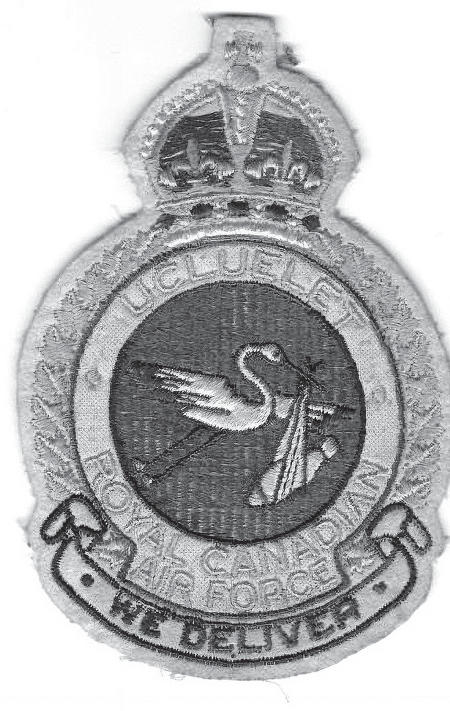
The motto of No. 4 Bomber Reconnaissance Squadron—“We Deliver”—and its symbol of a stork carrying a bomb in a diaper, made a colourful unit badge. When an air force base was later set up near Tofino, its symbol was Donald Duck holding an umbrella. Bea Brennan said the Ucluelet and Tofino crests were designed by Walt Disney Productions.16 An alternate unit badge with a West Coast theme was created for Ucluelet’s No. 4 Squadron. It featured an eagle with motto from the Chinook dialect: “Tikeh Klap Mesachee Tillikum,” meaning “seek the enemy.”17
Engineers chose the Ucluelet site for an RCAF seaplane base, the government bought the property from John Kvarno, and the Northern Construction Company was hired to clear land and build structures. By June 1940 the Ucluelet base was deemed ready for permanent occupancy—it was an overly optimistic assessment.
The construction crew left to build a base at Coal Harbour. The RCAF personnel arrived, ready to fulfill their mission to patrol the coast, maintain equipment, train on bombing and artillery, and protect the base. To their collective dismay, the base required not only protection, but construction. So, like pioneer settlers before them, they felled trees, bushwhacked with machetes, and dug out stumps, while slapping at mosquitoes and inhaling smoke from slash burns. Rain created a sea of mud, so they traversed the site on planks while building auxiliary roads. Leslie Hempsall reported that “the ultimate indignity” came when they were tasked with fitting the latrines with hardware.
Progress was bumpy. “The air force unofficial motto, Situation Normal, All Fouled Up,” prevailed.18 One SNAFU occurred when the buoys supplied for mooring the aircraft sank from the weight of their chains. My Uncle Art recalled that when locals helped build the seaplane base, he worked on the piledriver, building floats for aircraft moorage.
High tides caused salt water to drain into the water supply. An alternative source triggered allergic reactions in many personnel, owing to cedar contamination of the water.
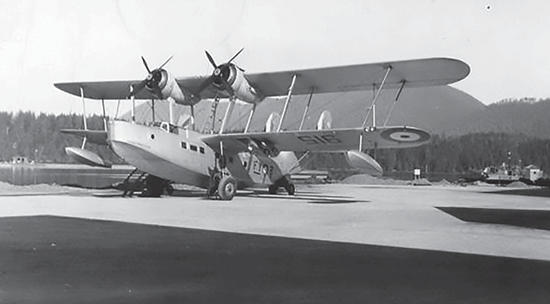
As the personnel struggled to create a functioning base, the stress was compounded by their aircraft. For several years, all the squadron had were Stranraer flying boats, obsolete craft made up of “fifty thousand parts flying in close formation.”19 To make matters worse, until proper maintenance facilities were ready, Ucluelet-based pilots had to fly dodgy aircraft to the Jericho RCAF base in Vancouver for repairs.
Shark float planes were another archaic species at the Ucluelet base. In 1942, crews celebrated the arrival of a Canso flying boat, their first aircraft that was not a prewar relic.20 The twin-engine Canso could fly great distances and land on both water and land. By the end of 1943, the Stranraers, a.k.a. “whistling birdcages,” were gone, replaced by nine Cansos and two Catalinas (which were like Cansos, but could land only on water).
Winter frequently brought clouds down to a hundred feet, “with planes sea-scraping at fifty feet.”21 Patrols were often “agropin in the rain.” However, as one pilot put it, “If you didn’t fly hereabouts in rainy weather, you wouldn’t fly at all.”22
The Crash of Stranraer 928
On December 30, 1941, just three weeks after the Pearl Harbor attack, Stranraer 928 headed straight out to sea. The crew of eight were on what should have been a four-hour mission—two hours out, two hours back. Half an hour out, one of the plane’s two engines started to sputter and smoke. The pilot turned the plane around to head back to base. Air gunner Sergeant Frank Rogers later described looking out the window midship and realizing “the treetops were awfully close.”23 The plane crashed into trees and plummeted through them to the ground, a little less than a kilometre from the base.
Sergeant Rogers came to in a plane full of oily smoke and broke a Plexiglass window. As he wiggled through it and dropped to the ground, machine-gun ammunition and flares set off by the fire exploded around him. His biggest worry was the flames licking at the 113-kilogram bombs under the wings. “The crash would not set them off, but I knew the heat would ignite the bomb detonators and BANG!”24
Rogers crawled about twenty metres through the snow before passing out beside a large stump. Three other airmen escaped the crash. The four others perished. Personnel at the base witnessed the plane disappearing, followed by a large cloud of smoke, and rushed to carry the wounded men to the base hospital. Rogers had a dislocated shoulder, bruises, cuts and burns. He never heard the verdict of an inquiry into the crash, but theorized the pilot was struggling to deal with a lack of power from the failing engine, while trying to figure out where on the partially frozen harbour he could land.
Trees near take-off and landing sites created risk, so Lyche Island in the centre of Ucluelet Harbour was logged. Sheila Mead-Miller commented, “It looked so funny to see the island all shaven and shorn.”25
More Personnel Arrive
In 1942, a contingent of the Royal Canadian Artillery set up on a rock in front of the Hilliers’ home in Port Albion. “These big guns would practice shots at the rocks outside the harbour and keep us all in suspense,” Elsie Hillier said.26 Local fishermen were concerned that the shots were killing large numbers of fish.
Army personnel did guard duty. The first to arrive was the Canadian Scottish Regiment; next came the Duke of Connaught’s Own Rifles and finally some men from the Veterans Guard of Canada, too old to enlist but determined to serve in some fashion. In February 1942, fifty American Radio Direction Finding personnel set up a radar early-warning device at Spring Cove. They lived in tents until accommodation was built.
When they left four months later, well-trained Canadian personnel took over, including George Gudbranson, who would remain after the war, raise his extended family in Ucluelet, and become a dedicated community member.
Given the questionable earlier aircraft and the challenging coastal weather, it is amazing that only thirty-seven men lost their lives during the Ucluelet station’s operational period. Sorties could last five or six hours, covering areas up to four hundred kilometres out to sea. The Ucluelet squadron responded to many false alarms, including a reported sighting of sixty Japanese ships eight hundred kilometres off the coast. The standard reconnaissance forays were set at 290 kilometres offshore; at one point, the powers that be reduced that to 160 kilometres, citing the unreliability of the aircraft. The airmen responded that 160 kilometres out to sea on an obsolete aircraft didn’t feel any safer than 290 kilometres.27 Accidents also happened on base. In May 1944, Corporal Hugh McKay died and three others were injured when a bomb exploded in the armament section.28
During most of 1942, Japanese submarines patrolled off the West Coast, but none were sunk or severely damaged. It was recorded that on June 20, 1942, Japanese submarine I-26 shelled Estevan Point Lighthouse, in the first attack on Canadian soil since the war of 1812.29 A colourful account came from Cougar Annie ( Ada Annie Rae-Arthur), who described seeing a submarine surface in Hesquiaht Harbour.30
Around twenty-five shells struck the beach or whistled overhead. The only damage was from a few fragments that hit buildings. The attack on Estevan is still disputed. There is no doubt it was shelled, as evidenced by witness reports and an unexploded thirty-six-kilogram shell found on the beach.31 Many shell casings were also found, most recently in 1973. The conflict is over who attacked the lighthouse. A conspiracy theory argues that US Navy ships fired the shells to stir up the war effort by scaring “the bejesus out of Canadians.”32 In 1973, Minoru Yokoda, commander of Japanese sub I-26, recounted how the first shells fell way too short: “I remember vividly my yelling at them, Raise the gun! Raise the gun!”33 Despite his claim of responsibility, the debate continues.
The shelling at Estevan caused much excitement at the Ucluelet base. A corporal chose two airmen to spend a month with him on an isolated beach, looking out for enemies who might come ashore from their subs for fresh air and exercise. Many personnel vied for the mission, wanting a change from the base. When the three dishevelled men returned a month later, the corporal complained that it had “rained like a bugger every day. The water was rough as Billy-be-damned,” and every time they thought they saw a periscope, it turned out to be a diving duck. One of the airmen added: “It was the pits!”34
While fulfilling their missions of reconnaissance and rescue, the Ucluelet personnel also created a functional base. A gardening committee was formed to beautify the area. An entertainment committee provided activities to raise morale on the isolated, frequently storm-ridden base. Available sports included fishing, swimming, the three Bs of basketball, baseball and badminton, and an annual track and field day. Social pastimes included bridge and poker, choir, chess and crokinole. One puzzling presentation was a pyrotechnic display put on to entertain locals during a blackout period, courtesy of the armament section.
Ucluelet musicians put on concerts in the Recreation Hall, a.k.a. the Rec Hall. The entertainment committee organized dances, creating a demand for dancing partners; crash boat M264 “scoured the shores of Barkley Sound for women, seldom with much success.”35 Spirits soared when the young women of the Adanac Ria Club visited the base. This group (“Air Canada” spelled backwards) was formed in Vancouver in late 1943 to fraternize with airmen and airwomen as part of the war effort. Their visits to the coast, whether in signature red blazers at dinners or in formal gowns at dances, always boosted morale. The adjutant of RCAF Ucluelet described them in his journal as “a bunch of swell girls.”36
The Young Men’s Christian Association helped acquire furniture, equipment and movies, which arrived aboard SS Princess Maquinna and SS Southolm. Popular movies included Look Who’s Laughing, Flying Fortress and Sin Town. A station newspaper called the Western Flight covered important news, including the night a roaming camp dog named Josephine “attended by anxious airmen…gave birth to eight fine pups” beneath the barracks.37
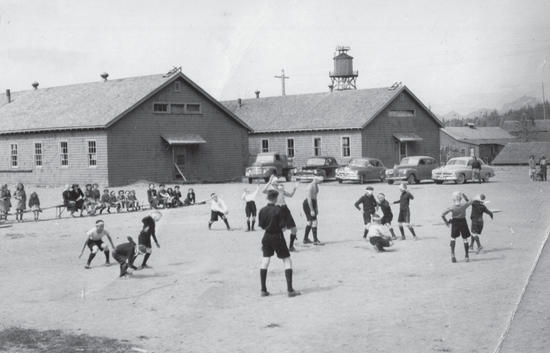
So many activities were on offer that leave time was cut in half. It was even suggested that personnel forgo city visits to spend their leave in Tofino, affirming a commonly held belief that those in charge of making these decisions were totally out of touch with reality.
Tent Town
A few airmen who wished to have their families with them found space in the one small hotel or in rented cottages, and a couple of them turned an old garage into apartments. But housing options were limited. This was solved when a few men set up “Tent Town” between the hotel and the seaplane base, on land supplied by hotel owner Stan Littleton. Described by a reporter as “one of the quaintest wartime mushroom habitations in Canada,”38 the tent homes housed nine air force men and their wives, as well as four children.
Flight Sergeant W.F. Balfour explained that he and others had set up the enclave after their wives visited and then, when winter arrived, “nobody was anxious to let his wife go. So they stayed all winter and suffered no ill effects.” They kept oil stoves going day and night. “It once rained for eight weeks straight but the canvas roofs stood up well.” When shown around the three-by-four-by-three-metre dwelling by Balfour and his wife, the reporter enthused: “A cosier place it would be impossible to imagine than this little gray home in Ucluelet.”
Balfour calculated he’d spent $150 on his abode, for tent, porch, lumber, radio, running water, cook stove and furnishings. “If I have to leave,” he said, “I’ll sell the whole shebang to the best buyer and may-be make a spot of profit.”39
The air force wives visited the beaches, played badminton in the village hall, and watched movies on the base. To counter local shopping costs, they put in orders that arrived weekly by boat. The wives living near the base were also offered occasional training. In August 1944, they were given “a six-day Anti-Gas Course,” culminating in a session in a gas-filled chamber.40
Many of the couples were young, and some were newlyweds. A wedding announcement in the Province newspaper of January 3, 1941, stated that Rory Rorison and his bride, Nona, were leaving to reside at Ucluelet’s RCAF station. The bride was elegantly attired in “a princess frock of woodbury rose crepe, featuring bracelet sleeves and full skirt” and a black felt hat intriguingly festooned with “hackle feather trim.” She would be “travelling in a black boucle coat with a silver fox, over her wedding gown.” (Hopefully she packed rainboots.)
Bea Brennan arrived in Ucluelet with her husband, George, in 1944 and considered herself lucky to have a house, although “there were no lights, no water lines, and no sewer lines.”41 The Brennans lived on the corner of Peninsula Road and Norah Street, then called D.F. Road because of the directional finder installation at the top of the hill. The commanding officer and his wife lived in a little house where the bowling alley now sits. He had a pipe connected to the seaplane base, a pipe that “mysteriously grew—down the road, around the corner, and into about six houses.”42 Bea said it was quite a day when the water was turned on—even though it was cold. The isolation and lack of amenities didn’t bother Bea and George—after the war, they remained in Ucluelet, George working at the Co-op and Bea managing the library.
Bea also recalled much excitement among the men on the base when they heard that female RCAF personnel were to be stationed in Ucluelet, “but alas, they were just rumours—war is hell!!”43
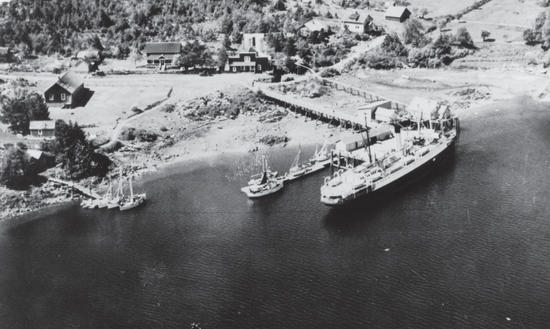
The base had a complementary relationship with the village of Ucluelet. “We used to hang around with some of them, you know, and we had a lot of fun,” Sheila Mead-Miller said. “They were all nice people.”44
Margaret Thompson, who was six years old when the war started, remembered a little “handgun” her dad made her so she could protect herself if the Germans attacked. She also recalled the blackout routine, when the village residents put tarpaper over all the windows every evening. Once a week, each child took twenty-five cents to school for war stamps. On Fridays, girls and boys alike knitted face cloths to send to the soldiers overseas. Three large army buildings had been built near the house Margaret lived in, adjacent to the present-day police station. (The house, later occupied by the Watt family, and even later by the Driftwood Restaurant, was destroyed by fire in 2012.)
Canso Crash in the Harbour
The Thompson home’s proximity to the harbour meant Margaret and family heard the boom when Canso 11019 crashed on June 9, 1944. The aircraft was returning from a routine mission and crashed near Lyche Island. Of the eight crew members, only flight navigator C.M. Amos survived.
Earl Mundy, who was then six years old, heard the noise and saw the dramatic crash from his home on the Hitacu waterfront.
Frank Hillier was a young boy at the time. He and his family heard a loud bang and rushed out into the lane. They saw smoke billowing up from the harbour and heard a voice hollering for help. Frank’s brother Don ran to the wharf to find a boat. His dad called after him: “Keep your head down. That noise you hear is live bullets.”45 The plane’s ammunition was exploding in the heat. At the wharf, Don found none of the rowboats were usable. The owners had taken their oars home, because the airmen had been “borrowing” the boats to visit the young women who worked at the cannery across the harbour.
When Don looked around, he saw the crash boat speeding from the base to rescue the lone survivor, who was swimming around surrounded by flaming oil. Frank recalled that two or three weeks later there were dead fish washed up around the harbour because of the explosion.
Charles Fraser, who worked as a chef at the time, remembered seeing a big pillar of smoke. The crash “was quite a jolt,” he stated, adding that one theory about the cause was that the plane clipped the trees at the end of Lyche Island (although some reports say the island had been logged because of the war, and other reports say the crash did not happen that close to the island). A second theory was that they hit something at the end of the bay, causing the depth charges to explode.46
A week later, the first body was recovered. Ironically, the retrieval of the last body happened on August 18, 1944, the same day orders came to close RCAF Station Ucluelet, and to relocate remaining personnel to RCAF Station Tofino.47
During the war, over a thousand RCAF air and ground personnel inflated Ucluelet’s population, which dropped to around two hundred when the seaplane base closed.
Postwar Playground
As kids, we played in trenches, bunkers and bomb shelters left after the war. Later, my daughters and their friends also played in them. They remain today, a reminder of different times. Many a youngster tore their trousers on barbed wire strung through the bush in areas of town, set up to keep out the enemy. Vic Foggett was hired as watchman of the deserted base, and Terry Smith recalled hiding from him behind a wood lattice while waiting to sneak into the area. He said it could be tricky, as the kids couldn’t avoid leaving footprints across the mudflats.
Frank Hillier recalled playing follow-the-leader with friends D’Arcy Thompson, Malcolm Mead-Miller and Ronnie Wesnedge. It was great fun climbing ladders to the top of the hangar and running around up there. It was less fun when he started down the ladder from a great height and the rotted rungs disintegrated beneath his feet.
Terry Smith recalled clambering around up there with his brother Mike, my brother Robbie and Brian White. “The ladders were rotten, the stairs were rotten…It’s a wonder one of us or all of us didn’t get killed.” They also climbed down into the storm sewer and navigated through that huge pipe.
Pacific Coast Militia Rangers
Some local men belonged to the Pacific Coast Militia Rangers (PCMR), a corps of the Canadian Army referred to as BC’s “home guard.” Unique to the West Coast, the Rangers were authorized on August 12, 1942. No. 102 Company Ucluelet covered Ucluelet, Port Albion, Stapleby and Wreck Bay. William Hillier was the captain from June 15, 1942, to August 14, 1943, followed by G.H. Gilroy-Moore, who led the group until it disbanded in 1945. My Uncle Art was an active member of the group.
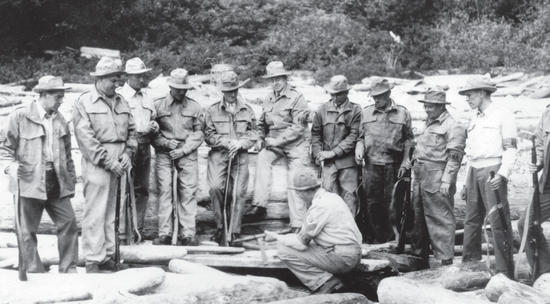
During my research, I discovered my father was the Ranger captain for No. 6 Company Clo-oose, a fact he never mentioned to me. He logged at Nitinat during those years. The military wanted Rangers who knew the local terrain, and Dad certainly fit the bill.
With their areas remote and widely spread, the Rangers could not easily assemble for training, so information was shared through a publication called The Ranger, first distributed in 1942. Topics included “Edible plants of BC” and “What to do with a tarp.” Not all training was covered in the magazines.
The article entitled “Know Where to Shoot” would have been a useful read before one Ucluelet Rangers incident. A local trainee was handed a gun. The rest of the local Rangers lined up behind him. When he squeezed the hair trigger, the rapid machine fire took over—the gun flew around wildly, spraying ammo in all directions. The local Rangers hit the beach, taking cover behind logs and driftwood.48
Sheila Mead-Miller said her husband Ken thought it would be safer fighting the enemy than being out on “their little tours” with the Rangers. “One or two of them…weren’t very careful with their rifles…He thought they might shoot each other. Safer really to have an enemy in front of you.”49
The PCMR disbanded on September 30, 1945.
The Gumboot Navy
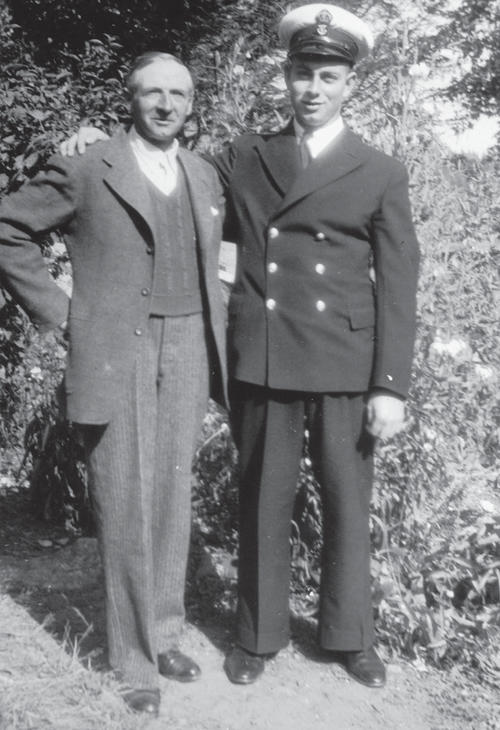
Another group protecting the coastline was officially named the Royal Canadian Navy Fishermen’s Reserve, but west coasters called it the Gumboot Navy because of their practical footwear. In the aftermath of Pearl Harbor, local commercial fishermen, as well as some tugboat operators, loggers and boat maintenance workers, were pressed into service to patrol coastal waters and aid in sea rescues. The skippers of the Gumboot Navy knew Vancouver Island’s treacherous western coast like the back of their hands. They were, however, directed by naval personnel from the headquarters at Esquimalt. The Gumboot Navy disbanded in 1944.
“Dear Mum and Dad”
After going overseas in September 1943, Bud Tugwell trained in central England and Scotland. He hit the beaches of Normandy with his unit on D-Day, 1944, to clear obstacles so the barges could land. Unlike many of his fellow soldiers, Bud wasn’t seasick on the way over to France. He credited that to eight years of west coast fishing.
Bud and his unit worked in water up to their necks while dressed in full battle gear. They were used to it, having been thoroughly trained for this exact event. Once they’d cleared the beaches, they headed inland.
On the following day, Bud wrote this letter to his parents:
"Dear Mum and Dad,
Well, I guess you have heard the news, and are beginning to worry about me. You have nothing to worry about though, as I never even got a scratch, although I think I must have lost about ten pounds in the first five or six hours.
We really have something to be proud about as some of us were the first on the beach, and we never had a casualty. I was really a scared little boy for a little while. In fact I don’t think there was anybody that wasn’t. We haven’t been doing much today, but there is sure an awful noise going on all the time. We sure have wonderful air support. The planes are over here all the time helping us.
The people over here are sure glad to see us. They all come out on the streets and watch us go by and hand us flowers and wave to us.
Well I must close now, Mum, and try and cook myself some supper. I will keep on writing once a week if I get the time.50
"
Their inland trek took them through France, Belgium and Holland to Emden, Germany. When in open fields, they “dug a hole and crawled into it for the night.”51
Bud and his unit were in Emden when the war officially ended, and they celebrated with beverages from a bombed-out liquor house. He said his happiest day was January 11, 1946, the day he was discharged.
Bud experienced a lot of artillery fire and recalled that “placing minefields and then going back out and digging them up again after the troops had advanced was a particularly unnerving experience.”52 He said none of them knew what they were getting into when they joined up, and that for many, the waiting period was worse than finally getting there and getting on with the job.