
- Home
- Contents
- Maps
- A Note to the Reader
- Preface
- Chapter 1: What Lies Beneath
- Chapter 2: Stewards of the Land
- Chapter 3: Arrival of the Uninvited
- Chapter 4: The Fur Trade
- Chapter 5: Of Whales and Whaling
- Chapter 6: Spreading the Gospel
- Chapter 7: The Names on the Cairn
- Chapter 8: More Settlers Arrive
- Chapter 9: This Perilous Coast
- Chapter 10: Amphitrite Point Lighthouse
- Chapter 11: Life-saving Boats and Coast Guard
- Chapter 12: Walking the Telegraph Lines
- Chapter 13: Boats, Planes and the Long-awaited Road
- Chapter 14: Japanese Canadians of the Coast
- Chapter 15: The War Years
- Chapter 16: All That Glitters
- Chapter 17: The Bounty of the Sea
- Chapter 18: Logging Heyday and “Nay Day”
- Chapter 19: Shopping on the West Coast
- Chapter 20: Answering the Call
- Chapter 21: Fun and Recreation
- Chapter 22: The Beckoning Beaches
- Chapter 23: Coastal Creativity
- Chapter 24: Tourism Then and Now
- Afterword
- Acknowledgements
- Notes
- Further Sources
- Image credits


Chapter 8: More Settlers Arrive
Settlers were drawn to the area by advertisements describing fertile land available for pre-emption. The price seemed too good to pass up—if they followed through on required stipulations (clear the land, build houses, outbuildings and fences), the land could be theirs for taxes paid. From 1911 to 1913, many settlers arrived on the west coast of Vancouver Island in search of a better life.
Although some early settlers were keen to welcome more people, Carl Binns felt sorry for the newcomers, saying: “Poor divils…Sent out to some God-forsaken swamp in the wilds miles from the settlement. Blast the government anyway!”1
The island’s west coast sounded like a veritable paradise. The Ucluelet branch of the Vancouver Island Development League advertised land which, when “properly drained, will develop good land for mixed farming, especially fruit growing.” The full-page ad touted “the best climate in the world,” elaborating: “fine in spring, summer and early fall, mild, a fair rainfall, and little snow. There are no extremes.” The ad also stated that “Long Beach, about seven miles from Ucluelet Harbour, is an ideal proposition for a summer resort.” The ad extolled the abundance of fish, including trout, salmon, cod and halibut. Regarding transportation, it spelled out the limited steamship schedule, but optimistically said “the Provincial Government is building new roads. A wagon road is being built from Alberni to Clayoquot passing through Ucluelet district.”2 This proved to be a hollow promise—the road would not push through for close to another half-century.
The Victoria Daily Colonist of January 19, 1911, reported the SS Tees sailing for the west coast carrying twelve men representing twenty families seeking pre-emptions in the San Josef and Ucluelet districts. The men were so keen that “in the event of their failing to obtain pre-emptions a number have decided to purchase land.” Later, in a Victoria Daily Colonist article published on December 3, 1922, one pre-emptionist would extol the land as “of the best possible description on the island.”
The Karns
The promise of prime farmland lured William Karn and his family to Canada. A crowd of relatives waved them off when they left Liverpool in February 1911. The second-class journey across the Atlantic aboard the Empress of Britain must have been both exciting and challenging for William, wife Kate, both in their early forties, and four daughters: Marjorie sixteen, Elsie fourteen, Norah six, and wee Mary, just ten months. Norah was terribly seasick on the voyage and begged her father to convince the captain to stop the ship until she fell asleep.
They were relieved to arrive in New Brunswick on February 18, 1911. Once on dry land, the family boarded a train. Norah later shared that “most of us suffered train sickness in the stuffy old coaches across Canada.”3
Upon arrival in New Westminster, BC, William left his family with Kate’s brother and sister-in-law, Walter and Faith Saggers, and their son George, and set off for Ucluelet. His brother-in-law Walter would later join him, as they were equal partners in a 320-acre pre-emption.
William’s first challenge was to get to Ucluelet. He travelled from Vancouver to Nanaimo by boat. Finding no means of transportation to Port Alberni, William hiked there by trail, then caught the steamship Tees to Ucluelet. More hiking awaited him. William’s “Pre-emption number 273” consisted of 160 acres between Kennedy Lake and Long Beach. The site he chose to build on was about a quarter mile inland from the present Wickaninnish Road. To get there, William walked from the head of Ucluelet Inlet by trail to Wreck Bay, then walked part of Long Beach, then went through the dense bush to the homestead site.
His daughter Norah later reflected: “I often wonder what Father’s reaction was when he found his 160-acre parcel of heavily forested, virgin land, and if he realized the enormity of the task before him to clear that forest and build a home for a wife and four girls. But tackle it he did—sawed down the trees (by hand) and used dynamite, fires and manpower to get out the stumps. No such thing as bulldozers or cats [Caterpillar tractors] to do the heavy work in those days. All the work was accomplished with hand tools. Having sold everything in England, there was no turning back, and with a sheer determination and English stubbornness, my Dad forged ahead.”4
William persevered in his goal to tame the land and establish a home. He hiked that route many times, laden with supplies, including a hundred-pound sack of sugar, sacks of rice and flour, and even a cast-iron stove. A builder by trade, he also carried many tools.
With most of his material supplied by the land, William hurried to build a home so he could bring his family to join him in their new life. He was strong and fit from years of manual labour and his recreational pastimes of “lightweight boxing and Indian club swinging.”5 He would later do a performance of club swinging at the community hall in Ucluelet.
In January 1912, the house completed, William brought his family from New Westminster. They came across by boat, took the train from Nanaimo to Port Alberni, then caught the steamship Tees to Ucluelet. The family of six then hiked the trail to Wreck Bay, along the beaches and up through the bush—all this while packing suitcases. It was rough and wild, a far cry from the stately homes and manicured lawns of England. Descendant Ann Branscombe said her grandmother must have wondered “where the hell they were coming to!”6
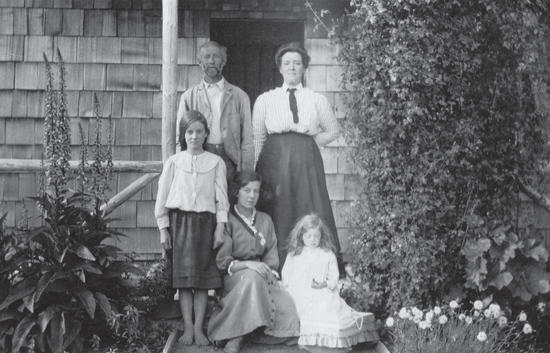
But a four-room house awaited them, solidly built and covered with hand-split cedar shakes. The house was fronted with a wide veranda, and attractive climbing roses and vines would eventually cover the posts. William found time to craft a rocking horse for Mary, naming it “Pierre Point Morgan.” Little Mary loved rocking on the front veranda, and Norah enjoyed the swing her father constructed there.
The family set about making the house a home, hanging pictures and arranging furniture, most of it handcrafted from cedar slabs by William. Mrs. Karn later padded the couch and easy chair with fabric stuffed with pine needles. One treasured piece of furniture was a small desk they had brought with them from England and carried along the trails and beaches to grace their new home. A rich English tapestry separated kitchen and living room.
Getting groceries was not a quick trip to the store. William hiked nine kilometres to the head of Ucluelet Inlet, then rowed a borrowed skiff five kilometres to Jansen’s Store in Port Albion, then five kilometres back to stow the boat and load the groceries on a backpack frame to carry to the homestead.
William built a corduroy road into the homestead.7 Though much of the area was swamp and bush, the Karns cleared some fertile land and grew vegetables, fruit and flowers, and feed for a few chickens and ducks, a horse and a cow. Owls and raccoons harassed the poultry. The horse fell in a ditch, broke its leg and had to be shot. The cow disappeared, presumed to have fallen victim to a cougar. (The children never saw cougars on the property but did see mother bears and cubs.) On berry-picking expeditions, the children hung red fabric on branches to avoid getting lost.
Winters were long and cold back then. Norah recalled lots of snow, and huge icicles hanging from the roof and trees. Supplying wood for the stove was a never-ending chore. In summer, the stove had to be kept going for cooking. There were several scares when sparks landed on the dry cedar shakes. One time, Mrs. Karn and the two youngest girls were the only ones home when the roof caught fire. She climbed a ladder and straddled the roof peak, pouring water until the fire was out. Young Norah climbed up several times with more buckets of water.
The Karns were a hospitable family, and many bachelors enjoyed home-cooked meals there. Daughter Norah recounted how an “erratic Englishman” named Charles Hughes would routinely, after the first course, excuse himself, stand up and turn around to loosen his belt, then sit back down and start on dessert. Another time, he politely declined a second helping of dessert; he said no, “but his eyes said yes. After a quick exit from the table…to loosen his belt a notch,” he came back for seconds.8
Despite all the work required for day-to-day existence, William made time to read, sing and study astronomy. The children’s lessons were not neglected, and they did well when they later attended public school.
Hopeful settlers continued to arrive, and William Karn, compass at the ready, helped them locate their pre-emptions. Fritz Bonetti, who would become one of Ucluelet’s long-time settlers, was thrilled to meet the Karns. The family was walking home along Wreck Bay and saw a little man approaching, waving his arms and speaking a foreign language. “None of us could understand him and of course he couldn’t understand us.”9 He later told them he couldn’t contain his excitement upon seeing a family.
Many settlers struggled with the harsh environment, and as time went by, more and more of them left. The promised idyllic life seemed nothing but a pipe dream.
The Almond family cleared their pre-emption and put up buildings near the Karn homestead. But they lost everything when a fire destroyed their home. Disillusioned, the Almonds moved back to Ontario.
Other pre-emptionists included the Hildebrands, Ken Alexander and a Mr. Beatty.
The Karns were among the first settlers to pre-empt that area and among the last to leave. Around the time World War I broke out, they reluctantly moved into Stapleby, a small settlement established around 1910 near the head of the harbour. There, the two youngest girls could start school. William put his masonry experience to good use, building fireplaces and chimneys for locals. He made a valiant two-year attempt at commercial fishing despite “the constant misery of sea sickness.”10
The four Karn daughters married, adding to the family tree. Marjorie married Wilfred Thornton; Elsie married Bill Hillier; Norah married Jack Thompson; Mary married my father’s eldest brother, Art Baird.
William Henry Karn passed away in Ucluelet on January 6, 1945, at the age of seventy-nine. His wife, Kate, carried on for another seventeen years, like her husband a well-loved and honoured member of the community. A write-up of her eighty-sixth birthday party, which I attended as a young child, gives a sense of her life: “The children had refreshments on the lawn where Carol Krogstad played ‘Happy Birthday to You’ on the accordion, afterward singing to the party.” It goes on to describe Mrs. Karn as “very active in her home, doing her own cooking and sewing, and…assisting in bottling over two hundred jars of vegetables for this winter. She carries on a large correspondence and is keenly interested in world affairs.”11
Kate Karn passed away on the morning of July 10, 1962, in Ucluelet, at the Fraser Lane home of her daughter Norah Thompson. She was in her ninety-fourth year. She is interred near her husband, William, in Ucluelet Cemetery.
Fritz Bonetti

Fritz Bonetti, who had been so excited to meet the Karns, arrived in 1911 to homestead near Long Beach. He had travelled from Switzerland to the US, then had crossed into Canada at North Portal, Saskatchewan, and continued on to Ucluelet. Fritz cleared five acres of his pre-empted land, put in a farm and nurtured a productive garden and fruit trees.
In 1919, Fritz left Ucluelet for Oregon in search of work. He returned to his pre-emption in 1922 and carried on homesteading.
In 1926, Fritz returned to Switzerland, planning to bring his widowed sister and her young son back to Ucluelet to live with him. Unfortunately, his sister died while he was there. Fritz settled the estate and returned to Canada with his now-orphaned nephew, six-year-old Enrico. They sailed from Cherbourg, France, arriving in Halifax in June 1926. Upon arrival, Fritz had a hundred dollars in his pocket and listed his occupation as “farmer.” From Halifax, they made their way to Ucluelet, where young Enrico became known as Henry.
Fritz was said to be the last settler to leave the pre-emptions around Long Beach. In 1931, he bought part of the old Vosberg homestead, and he and Henry moved into Ucluelet. Henry eventually built Ucluelet’s first bowling alley, which still stands with some alterations, on the site of his uncle’s former Ucluelet property on Peninsula Road, at the entrance to Ucluelet. When Fritz passed away in 1969 at the age of eighty-five, the song “Keep Your Eyes on the Prize” was sung at his funeral. It seems appropriate for such a tenacious pioneer.
The Fletchers
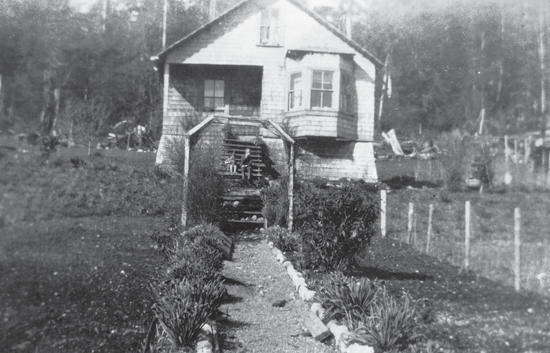
Chris and Hannah Fletcher came to Canada from England, where they had married in 1906. After arriving in Montreal in 1908, they crossed the country to Victoria and took on a pre-emption in Ucluelet. On the arrival documents in Montreal, Chris listed his occupation as “lumberman,” and his skills were put to good use in clearing his Ucluelet property.
The Fletcher family moved in from their pre-emption near Kennedy Lake to a scenic piece of land on Ucluelet Harbour. The site became known as Fletcher’s Cove. Their three children attended Stapleby School. As of this writing, the house still stands, surrounded by the gardens once lovingly planted and cared for by Chris and Hannah.
In 1929, Chris took on the position of lighthouse keeper at Amphitrite Point. They suffered the loss of two of their children. Daughter Violet had left Ucluelet to train as a registered nurse at St. Joseph’s Hospital in Victoria. She stayed on there for her nursing career and passed away in 1939 from pulmonary tuberculosis, at the age of twenty-nine. Son Clarence died in 1948 at the age of twenty-six, of polio.
After Chris’s retirement from Amphitrite, he and Hannah spent many years at their beloved Mount View before moving to Victoria, where Hannah passed away in 1978 at the age of ninety-five. Chris lived to the age of ninety-six.
The Saggers
Walter Saggers, like his older sister Kate (wife of William Karn), was born in England. By 1905, he was living in Brandon, Manitoba, where he married Faith Rosa Fuller, who had been born in Australia. Their son George was born in Brandon in 1906. Three years later, they headed for BC, eventually settling in Vancouver. Walter moved out to Ucluelet to join his brother-in-law William Karn on their shared pre-emption, and soon relocated to pre-empted land at Stapleby, where he was joined by Faith and son George. As well as clearing his land, Walter worked as a deep-sea fisherman.
Their son met his future bride at Stapleby School. Laura Inskip was a student at the school, where her mother taught while Laura’s father was away at war. George married Laura in 1932, at Noble Creek, BC. They had two children, George Jr. and Shirley. The Saggers were family friends, and I am proud to be named after Shirley.
Faith and Walter eventually moved from their Stapleby property down to Spring Cove, where they ran a two-storey store purchased from August Jansen. Playing pool above the store was a popular pastime for some locals. George, Laura and their two children also lived at Spring Cove until around 1939, when they moved into the community of Ucluelet. Shirley believes they moved because she had started school then, and although she was comfortable with the boat rides to school, her parents realized she was afraid to walk part of the way back home by herself, along the wooded trail between Ucluelet and Spring Cove.
Soon after World War II began, the Saggers families moved to Victoria, into houses directly across the street from each other. As George continued commercial fishing out of Ucluelet, Laura and the children returned for visits as soon as school was out each summer. George Jr. also became a well-known west coast fisherman.
The MacDonalds
James MacDonald’s family had a homestead next to Fritz Bonetti’s. James Blaine MacDonald was born in Ayrshire, Scotland, and came to Canada with his father, Thomas MacDonald, in 1907. James worked as a miner on Vancouver Island, in Extension, Harewood and South Wellington.
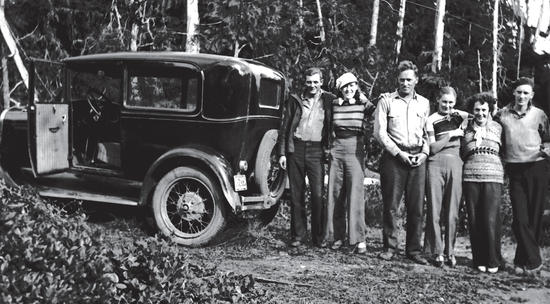
In 1912, James and his father, Thomas, were drawn to Ucluelet by talk of future development, including the possibility of a CPR hotel at Long Beach. Father and son worked on their pre-emptions, which were side by side in the area where the landfill now is. They built a cabin and returned regularly from Nanaimo to work on the land. In the 1930s, James, wife Jeannie and family lived on a second pre-emption. The present road to Tofino was put in through their property; their rhododendrons can still be seen at the side of the highway.
James worked on the road from the head of Ucluelet Inlet to Long Beach with a steam donkey engine. He and Jeannie had four children: Elizabeth, Thomas, Lilias (who married my uncle Harold Baird) and Jean. Disillusioned with life on the pre-emption, James and Jeannie eventually returned to the Nanaimo area, where James resumed mining.
The Thorntons
Wilfred Thornton was born in Nottingham, England, and emigrated to Canada in 1909, at the age of twenty-one. By 1910, he had arrived in Ucluelet, accompanied by his brothers Sid and Ed.
He pre-empted acreage at the head of Ucluelet Arm, living there in a small log cabin while he built a larger house. Sid and Ed helped with the building and then went to Australia, where they ran a bike shop before returning to England.
Like so many other settlers, Wilfred worked at a variety of jobs. He was a carpenter and owned a construction company, building many wharves and floats. He also worked as foreman on the first road between Ucluelet and Tofino. Wilfred spent long hours on the water, both commercial fishing and running a boat taxi service between Ucluelet, Port Alberni and other west coast destinations.
Wilfred married into another pre-emption family in 1915, when, at age twenty-six, he wed twenty-year-old Marjorie Karn. After serving overseas during World War I, Wilfred returned to Ucluelet Arm, and he and Marjorie had two sons, Philip and Harold. They had good farming land where “excellent garden truck was grown.”12
Sadly, Marjorie passed away when she was just thirty-eight. Wilfred shared his home with his widowed mother-in-law, Kate Karn, adjacent to Kennedy Lake logging camp, which was established on land he had sold to the forestry company MacMillan and Bloedel.
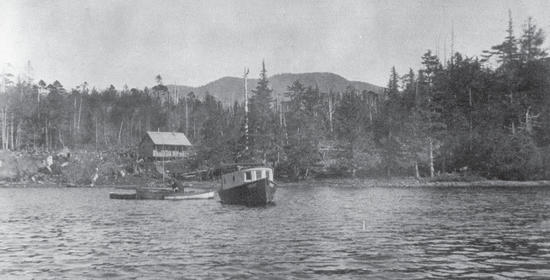
Their eldest son, Philip, ran a Ucluelet hardware store for many years. Younger son Harold logged, and he and his wife, Mavis, built and ran the Thornton Motel.
Edward Homewood
Edward Homewood left England aboard the Lusitania in March 1908. Not yet eighteen, he was off to the New World. Ed landed in New York and found work on a farm. Over the next two years, he worked his way through fourteen states, mainly on farms, but also by hanging wallpaper, doing laundry—he appreciated that the job was warm in the dead of winter—and logging in Washington state. From there, Ed headed up to Canada’s West Coast, lured by the “extravagant advertisements” about available land.13
Ed arrived in Ucluelet aboard the SS Tees in 1910, to commence work on his pre-empted 160 acres. He later said that “the government was betting the land against a promise the holder would stay with it for three years and make certain improvements.”14 Ed looked for local employment, finding jobs “neither steady or numerous.” He helped string the first telephone line between Ucluelet and Toquart and worked on the road between Ucluelet and Tofino. In 1911, he got hired for eighty-five dollars a month on the Ucluelet lifeboat and was a crew member when it capsized and one man drowned. Ed recalled that the supposedly self-righting boat turned bottom-up and stayed that way. He decided to try commercial fishing for the summer of 1912.
Then, like so many west coasters, Ed changed jobs again. In 1913, the Canadian Northern Railway was building along Alberni Canal—Ed ferried the workers back and forth in his launch. “I had to collect my round-trip fares before my passengers embarked,” he later chuckled, “for after a night in the Port construction workers had nothing left but headaches.”15
Pre-emption Landscapes
The hill outside Ucluelet that runs up past Wyndansea (the unfinished development sometimes referred to as “Wait and See”) was once called Holstein’s Hill, after the family who had a homestead halfway up the hill. That hill was later known as Garbage Dump Hill because of the large community garbage dump once situated on ocean-view property near the top of the hill.16 It is now commonly referred to as Water Tower Hill, for obvious reasons.
Johnson’s Beach, on the open ocean side of the peninsula, was named for Johnny Johnson, who lived in his log cabin on a homestead there. During the summer, Johnson tied up his float house and boat in a small area protected by rocks from the open Pacific. Closer to town, Jermett’s Beach was connected by two different trails, one to the road and one to Johnson’s Beach.
Stapleby: The Town That Is No More
Stapleby was situated in what is now the Willowbrae Road area. Pioneers who grew up there recalled a pretty settlement, with abundant fish in the bay, plentiful oysters on the beach and creeks flowing with fresh, clean water.
At the end of Willowbrae Road, there was a small wharf on the inlet. In 1914, a post office opened in Stapleby. George Grant, the postmaster, rowed down the inlet in his skiff to Ucluelet East for the mail. The other Stapleby residents also made the five-kilometre row in all kinds of weather to pick up freight dropped off at Sutton’s store and to buy provisions. Later, George Grant had a small store at Stapleby.
The Mawson family also ran a small store. John Mawson had been drawn to the west coast of Vancouver Island in 1910, by a CPR pamphlet advertising affordable land. The publicity showed “huge melons, big cherries and other produce which would grow on the west coast of Vancouver Island in such profusion as to be mindboggling.”17 The CPR promised to put a rail line through from Port Alberni to the west coast when enough pioneers arrived to warrant it. John Mawson promptly sold his London dental practice and his summer home on the Isle of Man and sailed for Canada. Upon arrival at Stapleby, he cleared his new property and lived in a tent. Soon, his wife and three children arrived from England, moving in with Charlie Hughes, a Stapleby bachelor. John Mawson built a two-storey home for his family and cut a trail through to the inlet.
Like many others, John signed up to serve in the First World War, lying about his age (he was too old). Off he went to serve in the medical corps, leaving Sarah and their three children to manage without him. According to her grandson Len “Digger” O’Dell, Sarah liked her life in the bush, and ran the small store on their property. The children rowed to Port Albion for goods and supplies.
John Mawson returned from the war to find his daughter Ella very ill. The family took her to Victoria, where Ella passed away at the age of fifteen from Bright’s disease, a kidney disorder. The Mawsons moved to Seattle and never returned to the coast. However, they kept up the payment of taxes, and years later, Digger O’Dell and his wife, Audrey, inherited the property, moving here in 1976. Digger found traces of his grandparents’ homestead, including the old well. Under a large windfall, he found some denture moulds, dental tools, medicine bottles and rifle shells.
When Stapleby was established, access to Ucluelet was along a rough trail. A 1913 government surveyor noted in his report that a wagon trail was being built from Stapleby to Long Bay (now called Long Beach). Kennedy Lake could be reached by walking a ten-and-a-half-kilometre trail.
Some of the Stapleby families originally pre-empted acreage out by Long Beach or Kennedy Lake and then moved in to be closer to town. As it was still quite a hike into Ucluelet, a school was built at Stapleby.
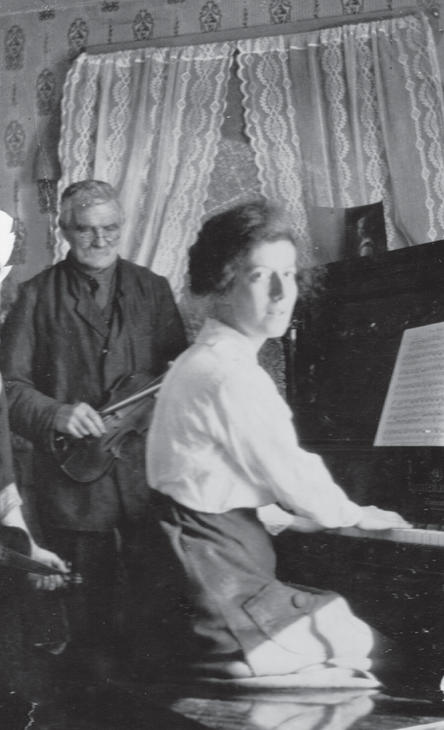
The Karns had a productive garden at Stapleby, and daughters Norah and Mary rowed a heavy skiff down the harbour each weekend to sell vegetables and eggs to the Japanese Canadian families. Norah kept chickens and later had a cow and a calf.
Music would frequently drift across the water from Stapleby. Scotsman George Grant played both bagpipes and cello. He often visited the Karns for their Sunday evening “music nights” and played his cello accompanied by Marjorie Thornton (née Karn) on the piano, and Elsie Hillier (née Karn), Dick Johnson and George Fraser on violin. Norah Thompson (née Karn) later described it as “Truly, never-to-be forgotten, glorious music!”
Marjorie’s piano was a gift from her father-in-law in England when Marjorie’s husband Wilfred was away fighting in World War I. Marjorie picked out the piano on a trip to Vancouver, and there was much excitement when it was delivered to her in Ucluelet aboard a whaling ship.
The people in and around Stapleby tried to cultivate small farms, but most of them found the soil unproductive and gradually moved away. Many years later, lots were sold off.
There are numerous homes in that unincorporated area now, both along the highway and in the large subdivision known as Millstream.
More Pre-emptions Available
Although many pre-emptionists moved into Stapleby to be closer to Ucluelet, or gave up and left the area entirely, enthusiastic advertising continued. In 1913, Ned Lee, secretary of the Ucluelet branch of the Vancouver Island Development League, was in Victoria and gave a glowing report on progress in the Wreck Bay−Long Beach vicinity. More land pre-emption was made available on June 15, 1914, when five thousand acres, mainly divided into forty-acre tracts, opened up for application. The 120 pre-emptions lay between Long Bay and Wreck Bay on the southwest and Kennedy Lake on the north. A newspaper article downplayed the difficulties of access to the area, citing frequent trips by the “new and commodious passenger steamer, Princess Maquinna.” The trail from Ucluelet to Kennedy Lake was described as “a good one for men,” and one that “could easily be improved to be passable for pack-horses. It is practically level for the whole distance.”18
Another 1914 newspaper article promoted Ucluelet’s farming potential, stating: “There is no place on the coast of the Province where large and small fruits and vegetables generally yield more certain and more abundant crops than here.”19
Even the extensive swamp lands were played up as ideal for growing cranberries, with George Fraser predicting that “one hundred barrels to the acre could be secured,” the berries would ship well, and the market was such that “this crop would, without doubt, be a paying one.”20
Although many early settlers found their newly acquired land to be not as described, the area continued to be promoted in glowing terms. In 1938, a 161-acre plot was advertised for sale. The land was located five kilometres from Long Beach and nineteen kilometres north of Ucluelet, and was described as having spruce, hemlock and fir. The seller, a resident of Braden Castle, Manatee, Florida, wanted $1,000 and “no trades,” and described the surroundings as “a region that will become the Florida of Canada.”21
The Mattersons
Although not west coast pre-emptionists, the Mattersons were key Ucluelet residents. Brothers Ron and Basil Matterson, who were from Yorkshire, moved to Tofino in 1925, where Ron (who had homesteaded his own Alberta farm at age sixteen) worked for the government lifeboat service, and Basil ran a store by the government wharf. Ron also worked in canneries and at the Kennedy Lake fish hatchery, and in the late 1930s and early ’40s he did some mining. For a time, Basil worked on road building, living with his wife, Mary, in a tent on Long Beach. When Mary became pregnant, she insisted on a house, so they moved into Ucluelet and Basil built their home, “Glendale,” on Peninsula Road. When Basil was hired to run the Imperial Oil Bulk station, the job came with a waterfront house, so they rented out Glendale to a senior military officer. Basil served as local justice of the peace, and also found time to operate a taxi business.

Basil and Mary raised their two children, Dal and Peggy, in Ucluelet until Dal completed Grade Five. The school didn’t offer Grade Six, so Basil moved his family to Pitt Meadows and resumed farming.
Ron and his bride, Ann, lived in Tofino until Ron’s job for the telegraph service brought them to Ucluelet in 1942.
When Basil and family moved away, Ron and Ann purchased Glendale and lived there for the rest of their lives. They were both avid gardeners and generously shared flowers, plants and vegetables with their friends and neighbours. Their flowers often graced St. Aidan’s Church.
Ron was Ucluelet’s first mayor. As an enthusiastic member of the Ucluelet Chamber of Commerce, he loved to show visitors around the area. Ann was an active member of St. Aidan-on-the-Hill. She lived frugally but gave generously to charities around the world, with a special focus on needy children and on the blind. Many of her friends said “knowing her has made them a better person.”22
Ron passed away at the age of seventy-nine. Ann lived until a month before her ninety-ninth birthday. The devoted couple had no children, and Ann left the house and property to St. Aidan’s Church.
After energetically working on many post-retirement projects, Basil passed away at the age of ninety-three. Like her sister-in-law Ann, Mary was blessed with longevity. She golfed well into her nineties, and passed away in Ladner at the age of 101.
Glendale was purchased by Glen and Donna Gable, who established a popular local restaurant, fittingly named Matterson House Restaurant. When the Gables moved away, they sold the restaurant to Sandy and Jennifer Clark. Both couples served excellent food in charming surroundings. When having a meal there, I often thought about how much the Mattersons would have enjoyed it, as they frequently welcomed people into their home.
When Sandy and Jennifer eventually sold Matterson House, the new owners, Ian Riddick and Anthony Pugh, remodelled the inside of the restaurant but maintained the heritage character of the exterior. They changed the name to Heartwood Kitchen, and carried on the previous tradition of good food, friendly service and community support, including the yearly Valentine’s Day fundraiser for the local fire brigade. Ron and Ann’s lovely plants still bloom around the building.