
- Home
- Contents
- Maps
- A Note to the Reader
- Preface
- Chapter 1: What Lies Beneath
- Chapter 2: Stewards of the Land
- Chapter 3: Arrival of the Uninvited
- Chapter 4: The Fur Trade
- Chapter 5: Of Whales and Whaling
- Chapter 6: Spreading the Gospel
- Chapter 7: The Names on the Cairn
- Chapter 8: More Settlers Arrive
- Chapter 9: This Perilous Coast
- Chapter 10: Amphitrite Point Lighthouse
- Chapter 11: Life-saving Boats and Coast Guard
- Chapter 12: Walking the Telegraph Lines
- Chapter 13: Boats, Planes and the Long-awaited Road
- Chapter 14: Japanese Canadians of the Coast
- Chapter 15: The War Years
- Chapter 16: All That Glitters
- Chapter 17: The Bounty of the Sea
- Chapter 18: Logging Heyday and “Nay Day”
- Chapter 19: Shopping on the West Coast
- Chapter 20: Answering the Call
- Chapter 21: Fun and Recreation
- Chapter 22: The Beckoning Beaches
- Chapter 23: Coastal Creativity
- Chapter 24: Tourism Then and Now
- Afterword
- Acknowledgements
- Notes
- Further Sources
- Image credits


Chapter 16: All That Glitters
In the local resource realm, mining takes a back seat to fishing and logging, but it has its place in the history of Ucluelet and adjacent areas. By 1865 there was lots of hype about gold and copper on the west coast of Vancouver Island, and hordes of hopeful prospectors arrived in the 1890s.
Early settler and certified assayer Will Sutton visited the Barkley Sound area in 1895, collecting rich ore samples, including gold. A newspaper article described Sutton as “greatly pleased with what he has seen…[and] confident of the brilliant future for this new mining district.”1 Will later delivered an extensive report describing the many precipitous cliffs he climbed in search of ore.
At a 1900 Victoria-based meeting of the Natural History Society, W.M. Brewster lectured on “The Mineral Resources of Vancouver Island.” Brewster, representing the New York Mining and Engineering Company, described “difficulties of an unusual nature” that came with mining on the west coast, explaining it was “necessary for the investigator to pack on his back all supplies, blankets, etc.…besides fighting his way through sallal, thickets of underbrush and swamps, where the growth of devils club is most luxuriant.”2 Brewster considered the western coast the most extensive mineral bearing section of Vancouver Island, and said that to develop mines there would require “much pluck, endurance, faith, and a long pocket book.”3
Gold fever truly hit Vancouver Island’s west coast in 1899, when gold was found in the black sand of Wreck Bay. Tyee Jack, whose Nuu-chah-nulth name was Klih-wi-tu-a, is credited with spotting the telltale glitter. One report has it that he landed on the beach for a rest from halibut fishing and discovered the gold, filling his pocket with the sand to show to others, including his friend, the early settler Carl Binns. Another version says he and Binns discovered the gold together when they stopped to make tea en route to Clayoquot with a mail delivery.
News of Wreck Bay gold stirred up great excitement in Ucluelet. Eager residents added their names to an alphabetical list, and claims were set up along the beach in that order. Tyee Jack took his place on the list. The group was soon organized under the name Ucluelet Placer Mining Company.
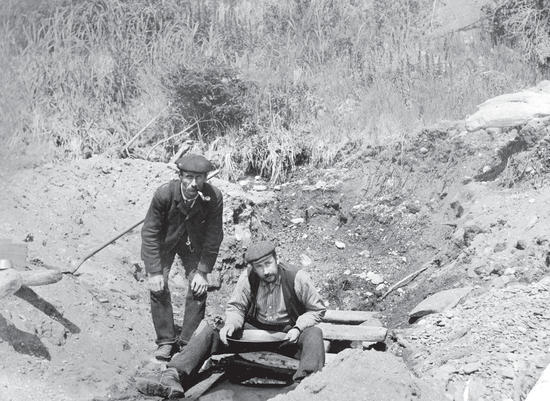
Newspaper accounts of Wreck Bay gold drew more prospectors. By April 1900, miners were sifting up to nine tonnes of gravel a day, with hopes of building a flume to make the process easier. A summer newspaper described Ucluelet residents as “jubilant over their mining prospect in Wreck Bay. They all have interest in it, and the results shown are far beyond their expectations.”4 The reporter described the gold as “flaky, but very easily saved. I saw a pan of very nice colours.” The gold was, he stated, “satisfactory and not a bogus affair.”5
Wreck Bay gold continued to enthrall newspaper readers. On July 14, 1900, the Daily Colonist reported the Willipa transporting a thousand dollars’ worth of Wreck Bay gold dust. The highly anticipated flume was expected to yield even more by bringing water to operate what the Times Colonist referred to as “some hydraulicking machinery.”6
Despite delays in building the flume, optimism reigned. “With all due respect to the Klondike region,” one workman stated, “there are very few more promising properties in that section than this one at Wreck Bay.”7
Others were less enthusiastic. The August 12, 1900, edition of the Daily Colonist reported the “hard-luck story” of three disappointed wannabe miners. They had caught the Willipa to the west coast, hiked out to the beach, found that all good claims had been staked, hiked back to Ucluelet and caught the steamer back to the city. One of them described the trail from Wreck Bay to Ucluelet as “so bad that I am afraid the police would not allow a verbatim report of what we’ve got to say about it.”
By August 19, 1900, about forty men were prospecting at Wreck Bay, most of them under the direction of James Sutton and a Mr. Graham. Carl Binns worked his claim independently, describing it as “turning out well.”8
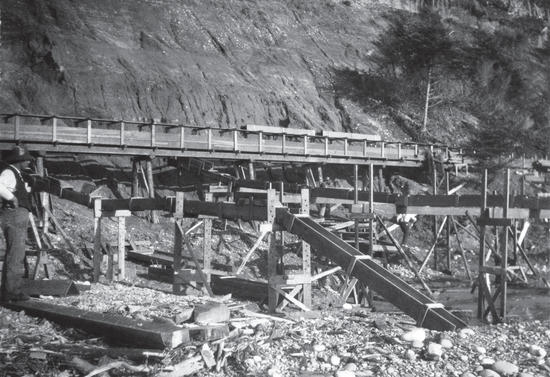
Foul weather continued to greatly limit mining time on the beach. Rough landing conditions meant supplies were sometimes taken back to Victoria undelivered, or lost when boats were swamped in the surf.
Will Sutton, ever the innovator, introduced a retort and furnaces to Wreck Bay so that the gold dust could be melted and made into gold bars.9 There was great excitement in June 1901 when the Queen City arrived in Victoria carrying three twelve-pound gold bricks, with a total value of $3,200.
By July 1901, doubts resurfaced about gold mining at Wreck Bay. An ad in the Daily Colonist on July 20, 1901, put it succinctly: “WRECKBAY—We have a small block of shares in the Uclulet Placer Mining Company for sale cheap.”
In August, a smaller gold brick was delivered to Victoria, and the Daily Colonist of August 30, 1901, reported that the miners had been “working in a bad streak for a space.” By 1902 many had concluded that gold mining at Wreck Bay was just a flash in the pan.
Some Chinese prospectors stayed on through 1903, when it was reported that fifty-three ounces, the first gold dust in many months, had been shipped to Victoria by Sing Lee, who leased the mining setup at Wreck Bay and worked it with a few other Chinese prospectors.10
When Carl Binns staked a claim at Long Beach, twenty others followed him. It was quickly discovered that when miners dug to any depth at Long Beach, sea water filled the spots, whereas at Wreck Bay the miners could sink to bedrock during the summer. Long Beach gold mining quickly fizzled out.
In 1911, some miners still persevered at Wreck Bay. Johnson Swanson, who had mined in Alaska, told a Nanaimo reporter that “your humble servant has been well rewarded for his months of fortytood [sic] in the vicinity of Ucluelet.”11
For prospectors, Wreck Bay continued to hold a romantic, albeit diminished allure. As late as 1929, the Daily Colonist reported people heading up by steamer from Victoria in search of Wreck Bay gold. Years later, one miner said that during the 1930s Depression, he panned enough gold in the summers to spend his winters in Japan.12
Panning for gold remains a passion for many enthusiasts. Those seeking gold must go elsewhere, as Wreck Bay, a.k.a. Florencia Bay, is now inside the protected Pacific Rim National Park.
Kennedy River Gold
In the late 1930s, the Department of Mines put in a plank road from the Ucluelet–Tofino road to the present-day Kennedy Lake Swim Beach. From there, mining equipment was towed across the lake on a float, landing a short way up Kennedy River (also known as Elk River because of herds of elk in its vicinity). There, another road led to a gold mining site five kilometres upriver. The second road started at a point called Gibson’s Landing, named after W.W. Gibson of San Francisco, who had a cabin and mine close by. The mines were to the east of Kennedy River. Those mines, the Leora and the Rose Marie, had existed since the early 1900s. Leora Mine, a.k.a. Lost Canyon Mine, was most productive, yielding substantial amounts of gold and silver between 1912 and 1915.
A thirty-metre open shaft remains on Gibson’s site, as well as semi-flooded underground workings. There are several other old gold mining properties in the area past Hydro Hill, as well as above Rocky Corner. Open pits and deep shafts make them risky places to wander.
Iron Ore
When, in 1900 in Victoria, W.M. Brewster gave his talk about the challenges of mining on Vancouver Island’s western coast, he mentioned extensive deposits of iron ore near Sechart and predicted they could be a huge source of wealth. In the ensuing discussion, Will Sutton, then geologist for the E&N Railway, advocated for “exact and business-like methods in the conduct of mining enterprises.”13
With all the mining hype, the Queen City was eager for a permit to carry powder and explosives to coastal miners, raising concerns about passenger safety. The mining community celebrated when the permit was granted. The Willipa also carried mining supplies and was fitted with zinc-lined storerooms to house the powder.14
In April 1901, H. Gager inspected mining sites near Ucluelet. He thought a smelter should be established on the coast, favoured a Barkley Sound location, and liked the sites near Ucluelet. Then Gager fell ill and cancelled his tour. The decision to choose a location was handed over to an expert from England, who considered Ladysmith a better site.15
Brynnor Mine
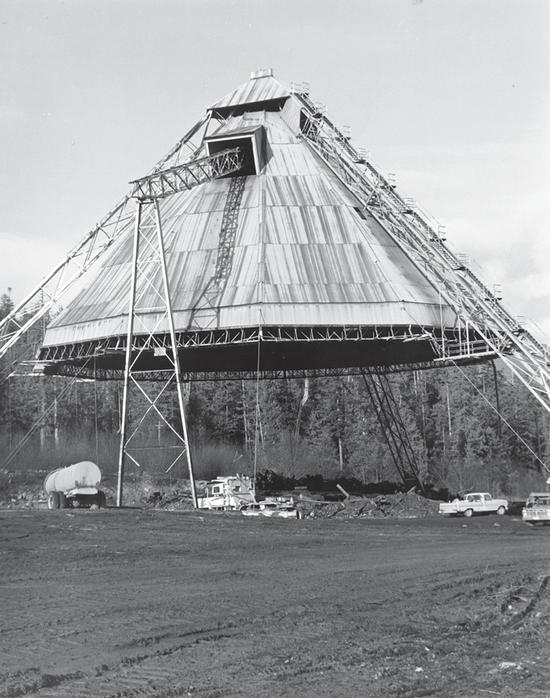
The potential for iron ore prospecting at Toquart Bay was documented as early as 1900.16 Iron ore deposits there were reported by a provincial government engineer in 1902, then further investigated in 1908 by the federal Department of Mines.17 Old-timers dug some pits in the area but didn’t reach the ore.
Then, in 1960, prospector Ed Chase from Surrey, BC, researched and recognized an opportunity for industry, as magnetite ore was in demand in Japan. After doing surveys, he and his backers sold the property to Noranda Exploration Company for over $1 million.18
Noranda Mines developed the Brynnor Mine, a small open-pit iron mine fifteen kilometres northeast of Ucluelet, on Draw Creek near Toquart Bay. The mine began operating in April 1962, bringing an influx of newcomers to Ucluelet. Brynnor Mine employed up to two hundred workers, some of whom lived on-site in a bunkhouse or trailers, and ate at the nearby cookhouse. Many others lived with their families in Ucluelet, some in houses barged in and set up on Pine Street, and on Peninsula Road across from the elementary school. Thirty-one new homes appeared in Ucluelet. School class sizes increased with new students, including the teenage children of mine manager Ted Wearing. (Their names all began with J, so it took some of us a little longer to identify them correctly.) A popular high school teacher, Norma Burns, was married to one of the mine staff.
Brynnor Mine yielded high-grade iron ore. In its most productive year, it produced 750,000 tons of concentrate for a million tons of ore. In all, it produced 4,480,940 tons of ore. The mine operated full-tilt until a labour dispute resulted in a strike in July 1966. It reopened in March 1968, then closed permanently after a year of working on a much-reduced scale. The inflated cost of mining the magnetite, coupled with decreased demand from Japan, meant an end to the operation of the Brynnor Mine. Most of the employees and their families left the Ucluelet area.
In 2004, Vancouver-based Logan Resources acquired the rights to the Brynnor Mine site. In 2008, as the value of iron ore shot up, they commenced drilling test holes. The company then held discussions with Toquaht Chief Bert Mack.19 Chief Mack filled them in on the Brynnor Mine history and informed them that some of the land they wished to do geochemical survey on fell within Tla-o-qui-aht Traditional Territory, so they would need to meet with them regarding their proposal.
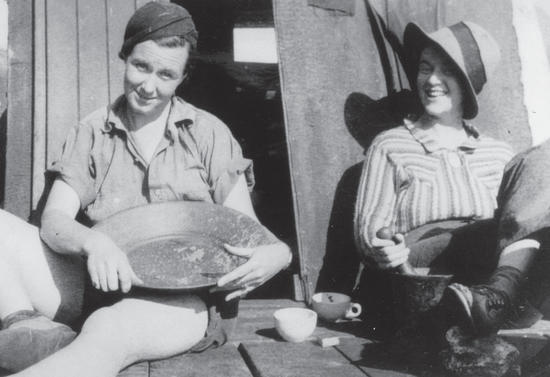
The land was transferred to the Toquaht First Nation in 2011. Soon, details of the harmful mining after-effects emerged—testing showed high levels of arsenic, selenium and cobalt in the tailings deposited when the ore was milled before shipping. Because of this pollution, Toquaht marina and campground were shut down by the BC government. The area has since been cleaned up and the businesses are open and thriving.
All of Vancouver Island’s west coast is highly mineralized. As many high-grade ore deposits across the world are mined out, low-grade deposits of gold and copper are in demand. Both minerals have been found in Clayoquot Sound, and a Canadian mining corporation has acquired mining rights and exploratory drilling permits. Citizens of the Tla-o-qui-aht, Hesquiaht and Ahousaht nations, and the environmental group Friends of Clayoquot Sound, keep a close eye on developments.