
- Home
- Contents
- Map
- Introduction
- Chapter 1: Casting Off
- Chapter 2: BC Built
- Chapter 3: First Stop
- Chapter 4: The Trail
- Chapter 5: Boat Landings
- Chapter 6: Seeing the Sights
- Chapter 7: Bamfield
- Chapter 8: Sheltered Waters
- Chapter 9: Barkley Sound
- Chapter 10: Shipwreck and Safe Harbour
- Chapter 11: Clayoquot Sound
- Chapter 12: Hesquiaht and Estevan
- Chapter 13: Nootka Sound
- Chapter 14: Zeballos and Esperanza
- Chapter 15: Quatsino Sound
- Chapter 16: Heading South
- Chapter 17: Tourism and Tragedy
- Chapter 18: Wartime on the West Coast
- Chapter 19: The Final Years
- Chapter 20: Tributes
- Acknowledgements
- Notes
- Bibliography


Chapter 6: Seeing the Sights
By mid- to late morning, depending on the quantity of goods and the number of passengers landed and loaded at Clo-oose, Captain Gillam charts a course northward, a safe distance off-shore. With any luck, passengers can, for a brief period—should the weather be sunny and the seas calm—enjoy extraordinary views of the rugged shoreline. Experienced coastal travellers know better, though, than to count on such idyllic conditions.
With the Maquinna barely underway, about 1.6 nautical miles (3 km) north of Clo-oose, passengers strain to pick out the entrance to the channel leading into Nitinat Lake. This channel, which extends that same length, bisects the West Coast Trail and connects the partially saltwater Nitinat Lake to the Pacific Ocean by way of a constricted tidal estuary measuring barely 100 ft (30 m) across at its narrowest point. Locally known as “the Gap,” currents surge through this opening at an alarming 8 knots, and the passage has capsized or sunk “more boats, with considerable loss of life, than at any other passage of its kind on the British Columbia Coast,” according to George Nicholson in Vancouver Island’s West Coast.61 To make navigating the Gap even more dangerous, a shallow sandbar lurks only a few metres below the surface on the outer side of the entrance. And in a final twist of danger, a reef known as Sawtooth Rock lies just under the breaking surf only 250 ft (75 m) from the sandbar.
Local lore dictates that to travel safely through the Gap any boats entering Nitinat Lake from the sea—and none larger than a fishboat or a medium-sized tugboat can even attempt it—must keep to the right of the channel when attempting the passage in the six minutes during slack tide. They should then let the current carry the vessel along rather than employ much engine power. Long-time westcoaster Ernest Logan tells of his experience going through the Gap:
"I had some good rides over the Nitinat bar, but I enjoyed them all, lots of fun. I got turned over there once in my fish-boat. That was the first time I’d seen a boat up-end! She didn’t roll over, she up-ended! She climbed the breaker and then the curl threw her right over. The hardest thing I ever tried to ride was the bottom of that boat, upside down, slippery with copper paint, and nothing to hold on to!62
"
The Lummi Bay Cannery lies just inside Nitinat Lake, and knowledgeable fishboat skippers delivering fish to the plant generally make the passage with little incident. Others, not possessing such a wealth of local knowledge, often come to grief. However, even highly experienced captains could misjudge these waters, sometimes with tragic consequences. Back in November 1918 a local fish-packer, the Renfrew, left the cannery carrying twenty-six jubilant cannery workers, all happy to be leaving after an isolated summer’s work. A large breaker struck the boat halfway through the Gap. The wave smashed a skylight causing water to stall the engine. An anchor thrown overboard failed to stop the boat going broadside and capsizing. Those below decks failed to get out, drowning thirteen of them. The Ditidaht people at Whyac—the village just inside the entrance—helped save the rest of those onboard.
The Maquinna only makes infrequent calls to service the needs of the cannery and the Ditidaht. On such occasions, as at Clo-oose, the experienced Indigenous paddlers come out in their canoes through the Gap to unload and load passengers and goods from the Maquinna’s cargo door.
Weather permitting, a few miles farther north Captain Gillam eases the Maquinna closer to shore, allowing passengers to more easily view the coast and to use their KODAK Brownie box cameras to take photographs. Sea caves and blowholes, caused by wave action eroding the roof of a cave, are visible; also seastacks, promontories and miles-long sandy beaches. Passengers can marvel at large colonies of sea lions lounging on the rocks, belching and barking. Eagles circle overhead on constant lookout for prey. Orcas might even appear, known at that time as black fish or killer whales.
Some geological features can be heard, as well as seen. Near the Nitinat Gap, one particularly large blowhole, of which there are many, lets off a mighty roar and a whistling sound at high tide that passengers may hear as the water shoots up and out of the opening, wooshing high into the air. Passing skippers often “mistook the noise for a foghorn, looked in vain for a lighthouse when the fog lifts.”63
A bit farther north, passengers look out for the Hole-in-the-Wall, a sea arch carved out of a rocky headland, which hikers on the West Coast Trail can walk under when hiking along the beach at low tide. If the tide is in, canoeists and kayakers sometimes paddle through without touching the sides or the top.
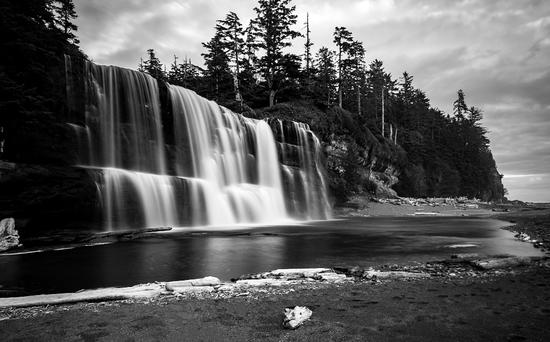
Soon passengers might raise their Brownies to take snaps of one of the great sights of this part of the coast, the magnificent Tsusiat ribbon waterfall, just north of Hole-in-the-Wall. This waterfall, which is 100 ft (30 m) wide, spills the water from Tsusiat Lake down a sheer 80-ft (25-m) cliff onto the beach. “Tsusiat Falls might well be described as the finest natural water cascade on the Island,” enthused George Nicholson.64 Local fishboat skippers can spot the falls from far out to sea and often use the spot as a landmark as they work the waters off the coast. The falls become most spectacular when the tide is high and big swells sweep inshore to envelop them, only to have them magically reappear when the swell recedes. At such times, though, safety does not allow the Maquinna to venture close enough for sightseeing passengers to witness this spectacular event.
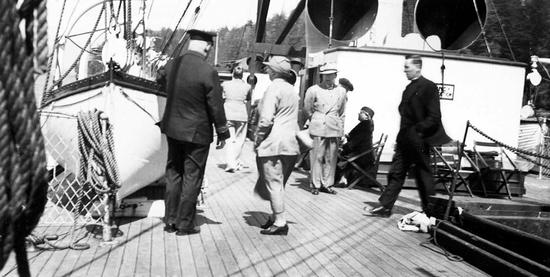
About this time on the voyage, the lunch gong sounds for the two lunch sittings and passengers once again make their way to the dining room. At this meal, it is quite likely the ship’s officers will join their guests, as they will also do for dinner. Rather than sit together at one table, the captain sits at the head of one table, while the first and second officers, the chief engineer and purser, all in full uniform, sit at the heads of other tables. This custom connects the passengers and tourists with the crew, and a familiarity and friendship grows with each trip. The officers also find time, in good weather, to promote deck games such as quoits and shuffleboard, and take time to point out places of interest, landmarks and the many historical spots along the coast.
A typical lunch menu begins with a choice of hors d’oeuvres of sweet pickles, anchovy toast or chow chow (a green tomato antipasto) followed by clam chowder or fried sole and tartar sauce. Or one might choose a lettuce salad or sliced cucumber or pickled beetroot. Hot dishes included baked pork sausage and mashed potatoes or braised oxtail à la jardinière or grilled loin steak served with fried onions. Cold dishes included roast ribs of beef, boiled ham or head cheese. Vegetables on offer: baked jacket or boiled potatoes and stewed turnips. Sweets to finish: queen pudding, pear pie or compote of apricots followed with imperial Canadian and Kraft cheese with crackers and tea or coffee to wash it all down. All this served by friendly, immaculately dressed waiters who, as Tofino’s Bob Wingen recalls, helped young lads like him figure out which utensil to use and when. “We were simply awestruck by the impressive surroundings. When we sat down at the dinner table on the boat there was all this beautiful dinner service laid out with so much cutlery. We were dumbfounded and the stewards would have to teach us how to handle it all. We couldn’t afford all those knives and forks at our house.”65
Some 2.7 nautical miles (5 km) farther north the ship passes the precipitous Valencia Bluffs, where the ill-fated SSValencia foundered in 1906. Pachena Lighthouse, built in 1908 as a result of the tragedy, sits atop the cliffs nearby and possesses the most powerful light on the Pacific Northwest coast, visible for 30 nautical miles (56 km) out to sea on a clear night, and always the first light seen by mariners approaching this part of the coast.
Another 11 nautical miles (20 km) onward, the Maquinna rounds Cape Beale and passes its lighthouse, the oldest on the coast, built in 1874. Not quite so powerful as that of Pachena Point, it can be seen 16 nautical miles (30 km) out to sea on a clear night. Rounding the cape, the Maquinna steams into the more sheltered waters of Trevor Channel to her next stop at Bamfield, just over 3 nautical miles (6 km) inside the channel.
In good weather, this section of the journey from Port Renfrew to Cape Beale offers some of the most spectacular scenery on the entire trip, and it was this that prompted Superintendent James Troup to explore the idea of selling the Maquinna’s west coast journey not just to locals, but to tourists as well.
This was not a new concept. The opportunity to sail up the west coast of BC on an adventurous cruise had fired the imagination of travellers for decades. In 1881 California’s Pacific Coast Steamship Company launched the successful Alaska cruise industry with monthly voyages to southeastern Alaska from San Francisco, and was later joined by the Alaska Steamship Company making trips out of Seattle. By 1886 travelling the west coast of Vancouver Island became a tentative recreational event, when the Canadian Pacific Navigation Company advertised in the Colonist “... that excursionists could travel to Clayoquot on the little steamer Maude.”66 The SSTees also carried some tourists on its voyages, usually sports fishermen and hunters travelling north from Victoria to stay at the hotel at Clayoquot. Soon after the launch of the Maquinna in 1913 the Canadian Pacific Steamship Company began cautiously promoting the attractions of the west coast for recreational travellers, something it then did on a much bigger scale in the 1920s and 1930s.
On this summer trip in 1924, the weather has proved remarkably balmy. However, many of the stops made on this stretch of coast would have been impossible in harsher weather, and sightseeing would have been out of the question. The impressive meals would not have been served in such lavish style. Aboard the Princess Maquinna in the winter months, and in severe storms, sometimes even the captain and crew faced seasickness. The cooks in the galley did their best for the hardier passengers who were not seasick, and for the crew. They cooked dozens of hard-boiled eggs, which the crew carried in their pockets, eating them when they could, as the ship heaved and tossed for hours, even days, on end.
In March 1934, 17-year-old John Evans paid $3.60 for passage on the Maquinna from Victoria to take a job as a helper at the Carmanah Point Lighthouse. His vivid description of the journey north of Port Renfrew, cited in Jan Peterson’s book Journeys, indicates how passengers coped—or didn’t cope—during epic west coast storms. Evans’s trip was rough from the very beginning, worsening dramatically as the hours passed:
"Now instead of pitching like a bucking bronco, the Maquinna was rolling and pitching. I used to think the water on the east coast of the Island could get rough, but this! I couldn’t believe it... Boy, did I get seasick. Then, as if that wasn’t enough rough treatment, one of the crew came round and asked us to stand up, so he could tie everything down... My sea-legs just wouldn’t hold me steady. In my seasick stupor, I watched the crewman fasten down the furniture. Even the piano was hooked down. By this time I was beginning to wonder what I had gotten myself into... I remember someone telling me I would probably have to continue on up to Bamfield instead of Carmanah Point as planned, since it was doubtful that anyone would be out to meet the Maquinna due to the stormy weather. They told me that I would be taken back to Carmanah Point Lighthouse by lifeboat. This new arrangement didn’t appeal to me very much, but there was little I could do about it.
By this time I was so miserably seasick that I decided to go out and get some fresh air. I managed to stagger my way to the door, congratulating myself for not falling flat on my face. The angle at which I had to walk was first up, then down, at which time I fell against the door. I waited until the ship righted herself again, then opened the door. The sight that met my eyes was terrifying. All I could see was a mountain of water! I’m sure it must have been fifty feet high. Luckily one of the crewmen came and grabbed me or I would probably have been washed overboard. He warned me not to open the door again.67
"
All this happened before Evans arrived in Clo-oose, where he managed to survive the dugout trip to the beach and eventually make his way to the light station at Carmanah, where he remained for a year.
On December 30, 1931, the Daily Colonist reported that storms raging along the coast had delayed the Princess Maquinna at least twenty-four hours in reaching the northern stops on her route, so no one there received mail or Christmas supplies on time. But the newspaper pointed out that “Worse off still were the settlers living at Clo-oose, Carmanah, Hesquiaht, Estevan and Lennard Island, for at all these points Maquinna was unable to call, and in all probability will not be able to do so on the southbound trip either, so great are the seas.”68
Four years later, in another legendary storm, with Captain “Red” Thompson in command, the Maquinna left the shelter of Victoria harbour on December 22, 1935, and headed out into hurricane force winds of up 110 mph (177 kph). The storm had stripped a roof from a house in Victoria and left the city without electricity for hours. Thompson bypassed Clo-oose, and when he reached Cape Beale at the entrance to Barkley Sound, the going became really tough. According to the Colonist:
"Captain Thompson braced himself in the wheelhouse and nursed his gamely struggling ship through the holocaust. He had to fight it out as there was no place to run for shelter. In every series of seas, there is always a bad one, which reaches higher than the others, hoping to claim a victim. Thompson had his ship snugly battened down and everyone aboard was warned to have a secure hold. He also took the precaution of ordering all his seamen and engineers—save one in the engine room—to leave the lower decks. When he saw the sea coming he blew the whistle for all hands to brace for the onslaught. Then came the big sea which towered over the Maquinna and Thompson watched it tumble over his ship, tossing her almost on her beam ends. Would she come out of it?69
"
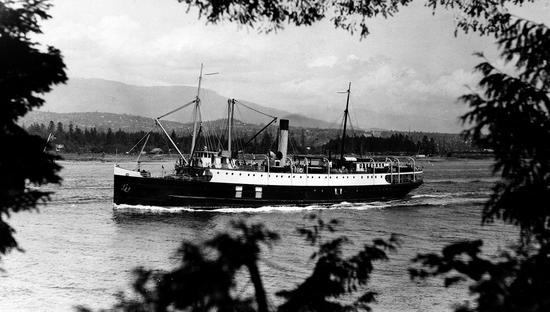
She did. Slowly the bow of the Maquinna rose to the surface and the rest of the ship emerged. A quick check of the vessel found she was still sound and little water had remained on board. But the freight deck was a shambles. Christmas presents, which had been ordered by mail, and consignments of liquor, turkeys, oranges and other edibles had been strewn amid the heavier freight, all of which had shifted. All crockery in the galley had been smashed and anything that wasn’t bolted in place careened around with the roll of the ship. The piano broke her moorings and smashed against the side of the ship. Thompson eventually eased the ship into Bamfield where it took eight hawsers to secure her to the dock.
According to long-time Tofino resident Bob Wingen, who made his first of many trips on the Maquinna as a week-old baby in 1926, when his mother brought him back home from Victoria: “They had a nurse on the Maquinna, and she was a terrific person. If you were coming and going from hospital she would put you in a stateroom and look after you. But the stewards looked after those who were seasick and there were lots of buckets aboard for people to be seasick into.” Bob worked with boats all his life, at his father’s (and later his own) boatyard in Tofino. “The Princess Maquinna rolled a lot but you never had to be afraid of her. There were times when the captains had to heave to for tides, but she was a very good sea-boat.”70
As the Maquinna nears Bamfield on this journey in 1924, Captain Gillam swings his ship well out into Trevor Channel so he can guide his vessel straight into Bamfield Inlet to dock in front of the cable station. Gillam liked to load as much heavy cargo into his forward hold as he could so that his ship’s bow rode “down by the head,” which now helps him make the tricky approach to the dock. “The entrance to Grappler Creek [Bamfield Inlet], on which the cable station stood,” wrote Gus Sivertz in an article in the Victoria Times, “requires a vessel to make an acute right-hand turn or to come in after standing well out off shore and making a wide sweep, through the mouth of Barkley Sound, which could be dirty. With his ship deeper by the bows Capt. Gillam would just give the rudder a sharp kick and she would turn sharply on her nose and then straighten out for the landing.”71
As the Maquinna enters Bamfield Harbour the ship’s whistle sounds—“the most welcome sound on the West Coast,” writes Bruce Scott. “Her whistle was unmistakable. It had a pitch all its own and almost invariably faltered on the last note of her ‘entering port’ signal. Like a young boy’s voice, it always broke and ended in a high falsetto.”72 On the port side, the passengers’ eyes are transfixed by the imposing building dominating the inlet. There, well above Bamfield’s waterfront, stands the Trans-Pacific Cable Station building, the biggest building on the whole west coast—which, for sixty years, played an all-important role in international communications.