
- Home
- Contents
- Map
- Introduction
- Chapter 1: Casting Off
- Chapter 2: BC Built
- Chapter 3: First Stop
- Chapter 4: The Trail
- Chapter 5: Boat Landings
- Chapter 6: Seeing the Sights
- Chapter 7: Bamfield
- Chapter 8: Sheltered Waters
- Chapter 9: Barkley Sound
- Chapter 10: Shipwreck and Safe Harbour
- Chapter 11: Clayoquot Sound
- Chapter 12: Hesquiaht and Estevan
- Chapter 13: Nootka Sound
- Chapter 14: Zeballos and Esperanza
- Chapter 15: Quatsino Sound
- Chapter 16: Heading South
- Chapter 17: Tourism and Tragedy
- Chapter 18: Wartime on the West Coast
- Chapter 19: The Final Years
- Chapter 20: Tributes
- Acknowledgements
- Notes
- Bibliography


Chapter 4: The Trail
In the twenty-first century, thousands of hikers lace up their boots every summer and set forth on the rugged hike along what is now known as the West Coast Trail. For this 47-mile (75-km) hike, which usually takes between five and seven days to complete, they load their backpacks with a sleeping bag, tent, food, wet gear and changes of clothes. Stretching from Port Renfrew to Bamfield on Vancouver Island’s west coast, the trail has grown so popular that hikers must reserve months in advance, and pay a hefty fee, to be allowed to embark on what many call “the trip of a lifetime.” The trek can be hazardous, some hikers at times suffering injuries and exhaustion, but such setbacks are minor in comparison with the death and disasters that occurred along this stretch of coast a century or more ago.
Throughout the nineteenth century, sailing ships lay at the mercy of strong southeast gales and powerful currents that drove many of them onto the rocks and beaches of Vancouver Island’s exposed west coast, in particular between Port Renfrew and Bamfield. This section of the coast became known as “the Graveyard of the Pacific.” In the forty years prior to 1906, 56 vessels foundered and 711 people lost their lives42 on this hazardous stretch. Because of this loss of life, the Canadian Federal Government provided funds to build the Dominion Life Saving Trail, or Shipwrecked Mariner’s Trail, with the aim of aiding survivors of ships wrecked along that portion of the west coast.
Sailing ships heading into Victoria and Puget Sound from the Pacific Ocean often hove to at the entrance to the Strait of Juan de Fuca, where it is 12 nautical miles (22 km) wide, waiting for contract-seeking steam-driven tugs to come out and tow them into safer waters. However, with no radio communication, storms or fog often prevented those tugs from finding the waiting windjammers, and the tugs and ships often did not make contact. “Standing out to sea certainly offered no assurance of safety,” writes Ted Rogers in his Shipwrecks of British Columbia. “So long as visibility was fair and the guiding beacon of Cape Flattery could be seen, the old-time skipper had a winning chance. But when the weather thickened, it was inevitable that his ship would ride on the offshore current sweeping the coast of Washington and the shores of Vancouver Island. At times the current, aided by a strong southeaster, would carry a vessel a considerable distance before danger was recognized.”43 Strong and prolonged southeastern gales drove sailing ships up and onto the rocks and the shores of southwestern Vancouver Island, and sometimes took them well up the coast, occasionally as far as the Gulf of Alaska.
With no reliable weather forecasts to warn of impending danger, ships fully laden with lumber, ore or other products also headed out of the Strait of Juan de Fuca, and even in summer they could encounter storms and thick fog. “If a bearing was not obtained from some recognizable landmark and the ship was out of horn range,” Rogers writes, referring to Cape Flattery’s foghorn, “the skipper knew he could be in for trouble. Sometimes the fog would lift for a spell to reveal a point of land. If ‘the old man’ was able to identify his landfall, he was reasonably safe continuing on course; if he was mistaken—and such was the case all too often—his ship would end up on the treacherous rocks with all hands lost... Each year, the foaming reefs of Vancouver Island’s east and west coast would be strewn with the wreckage of ill-fated ships which had become trapped near the shore in storm or fog.”44
In response to this danger, the Federal Government’s Department of Marine and Fisheries built a number of lighthouses—Cape Beale in 1873 and Carmanah Point in 1890—and supplied some communities, including Bamfield and Tofino, with lifeboats. However, it took one of the worst maritime disasters in BC history to instigate the building of the Dom inion Life Saving Trail, later known as the West Coast Trail. In 1906, while seeking the entrance to the Strait of Juan de Fuca, the passenger ship SSValencia ran aground off Pachena Point near the southern entrance to Barkley Sound. The ship was over 27 nautical miles (50 km) off course on its run from San Francisco to Seattle and Victoria. One hundred and thirty-six people lost their lives when the ship steamed, at 11 knots, up onto the rocks.45 The disaster prompted the Canadian government to launch a Commission of Inquiry, which recommended the construction of a Dominion Life Saving Trail along the edge of the coast that would allow shipwrecked passengers and crew to make their way on foot north (to Bamfield) or south (to Port Renfrew) to get help.
In June 1907, using the $30,000, or $1,000 per mile, allocated by the Federal Government to begin the project, a crew of “... 30 or 40 workmen,”46 under the direction of foreman J. McDonald, began building the trail, starting at the north end near Bamfield. Using hand tools and a few horses and cutting whatever lumber they required from the abundance of nearby trees, by the end of October they had completed 22 miles (35.4 km) of trail, or nearly half the distance required.
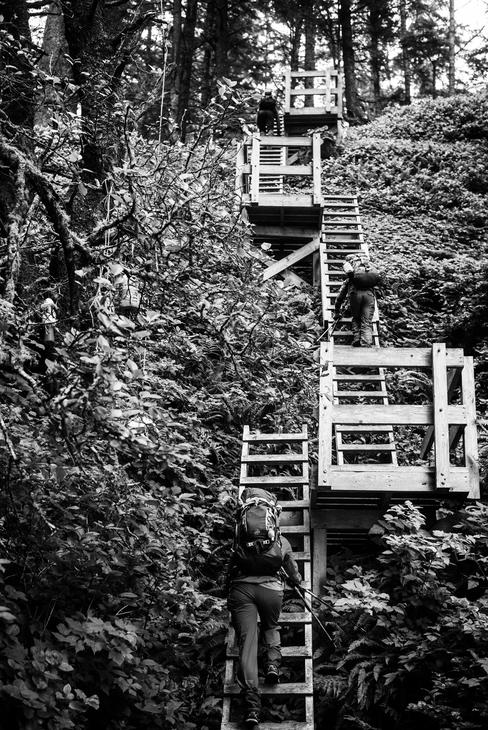
The workmen followed the route of an already existing telegraph line that, between 1889 and 1891, had been strung from tree to tree along trails used for centuries by the First Nations people of the area. The trail had a full view of the ocean for most of its route, even using foreshore beaches. At the northern end, from Bamfield to Pachena Point, the trail proved easy to build, allowing it to be 12 ft (3.5 m) wide, but for the rest of its more rugged journey the trail is only 4 ft (1.2 m) wide. The harsh terrain required the trail builders to construct 130 bridges and 70 ladders, and when they encountered four very deep river gorges, they fashioned aerial trolleys with boatswain’s chairs hanging from them. People using the trail pulled themselves over the gorges using a continuous loop of wire (not unlike a clothesline) while sitting in the boatswain’s chairs. Every 5 miles (8 km) or so along the trail, the workers constructed small cabins, equipping them with blankets and rations as well as directions and maps of the trail. Each cabin also contained a telegraph key connected to the nearby telegraph wire, with instruction in several languages on its use. Two Lyle rocket guns were stationed at the Bamfield Creek and Clo-oose cabins. These enabled local inhabitants to aid in nearby rescues by bringing a horse to carry the heavy guns down to the shoreline, where they used them to fire a rocket with lifelines attached to a distressed ship so that survivors might perhaps be able to reach shore.
Work continued on the trail for four years. When finally completed in 1911 the Department of Marine and Fisheries arranged for coast guards to patrol the trail daily to ensure the telegraph line remained intact and to look out for vessels in distress. Once finished, the trail needed constant repairs, especially to fix damage done by winter storms. This work was carried out by men like John Logan, who lived at Clo-oose from 1894 until his death in 1938. Logan became legendary for his dedicated work as a telegraph lineman and as a trail custodian, and for saving many shipwreck survivors over the years.
The Dominion Life Saving Trail, as it was known, had been fully operational for two years before the Princess Maquinna began plying her way up and down the west coast. Mercifully, neither she nor her passengers would ever make use of it, nor could they glimpse any sign of it from the ship’s position offshore as we follow her course in 1924. But the trail was there for them and for all who sailed or steamed up the west coast, serving as a constant reminder of the dangers of the waters on which they travelled.