
- Home
- Contents
- Map
- Introduction
- Chapter 1: Casting Off
- Chapter 2: BC Built
- Chapter 3: First Stop
- Chapter 4: The Trail
- Chapter 5: Boat Landings
- Chapter 6: Seeing the Sights
- Chapter 7: Bamfield
- Chapter 8: Sheltered Waters
- Chapter 9: Barkley Sound
- Chapter 10: Shipwreck and Safe Harbour
- Chapter 11: Clayoquot Sound
- Chapter 12: Hesquiaht and Estevan
- Chapter 13: Nootka Sound
- Chapter 14: Zeballos and Esperanza
- Chapter 15: Quatsino Sound
- Chapter 16: Heading South
- Chapter 17: Tourism and Tragedy
- Chapter 18: Wartime on the West Coast
- Chapter 19: The Final Years
- Chapter 20: Tributes
- Acknowledgements
- Notes
- Bibliography


Chapter 12: Hesquiaht and Estevan
After clearing Stewardson Inlet and the Indian Chief Copper Mine the Princess Maquinna steams back down Stewardson Inlet, then southeast and south down Sydney Inlet until she reaches open water beyond Sharp Point at the end of the Openit Peninsula. From there she heads north, and on her starboard side passes Refuge Cove, which boasts one of the area’s most notable geological features, invisible from the ocean.
Every minute, the hot springs here produce 454 litres of water at a constant 52° C. These springs have been highly valued for centuries by the local Nuu-chah-nulth people, who called it mok-she-kla-chuck or “Smoking Water.” In more recent times, passing boat crews and fishermen sometimes stopped to relax in the springs, where they would soak, wash the sweat and grime off their bodies, and clean their clothes. On this trip in 1924, however, the Maquinna steams past the cove without a second glance; with no one living there on a permanent basis, there’s no need to stop. The place has changed immeasurably since 1924: now known more commonly as Hot Springs Cove, it has a well-established Indigenous village, a settler community, and has become one of the most popular tourist destinations on the coast.
Victoria-born Ivan Clarke saw the potential of Refuge Cove before other settlers. Clarke had been selling groceries and supplies from a converted fish packer on the west coast, and wanted a land base. In 1933 he pre-empted two large parcels of land in Refuge Cove, including the mile-long (2-km) trail to the hot springs. He established a store, becoming the first non-Indigenous resident of the cove. From the outset, he and his family relied heavily on connections to the Maquinna. In January 1935, with his store and a couple of habitable dwellings established, Clarke sent for his fiancée, Mabel, in Victoria. He made his way over to Ahousaht to meet her when she arrived aboard the Maquinna, and Rev. Joseph Jones of the Presbyterian Mission married the two aboard the ship. Captain William “Black” Thompson gave the bride away; Mary Livesley of Ahousaht and the Maquinna’s chief engineer Donald MacRaild acted as witnesses.138 The newlyweds spent their honeymoon night aboard the Maquinna.
Clarke’s enterprise grew to include a gas dock, a post office and eventually a fish-packing plant, prompting the Maquinna to begin making regular stops at Refuge Cove. Mabel became pregnant with her first of eight children, and when the time for the birth approached she would board the Maquinna and go to Victoria to have the baby. Ivan and his family travelled up and down the coast many times on “Old Faithful” and developed a great love for her. When the Maquinna retired from service in 1952, Ivan, who happened to be in Victoria at the time, attended the initial dismantling of the ship. He purchased all the ship’s keys, including the stateroom keys, which are still in the possession of the Clarke family today. Later still, in 1955, Ivan and Mabel donated 14 of their original 48.5 hectare pre-emption to the provincial government for a park, suggesting the word “Maquinna” should be used in the park’s name. The provincial government later acquired substantially more land surrounding the Clarkes’ donated property, and the now 2,667-hectare park bears the name Maquinna Marine Provincial Park.
Ignoring the cove, the Maquinna steams northwest through open waters for Hes quiaht village, located on the southeast side of the Hesquiaht Peninsula, at the mouth of Purdon Creek and fronted by a wide beach. This is the main village of the Hesquiaht First Nation and lies a short distance east of Estevan Point. In August 1774, four years before Captain James Cook arrived at Nootka, the Spanish vessel Santiago anchored off Estevan Point. Captain Juan Josef Pérez Hernández had been sent north from Mexico by his superiors to explore the northwest coast. When some of the Indigenous people saw the ship they hid themselves in fear, never having seen such a ship before, but a number of courageous warriors tentatively approached the vessel in their canoes. Pérez and his crew traded with them, obtaining sea otter skins and conical cedar hats in return for the knives, silver spoons, cloth and abalone shells the Spanish brought with them from California. This marked the first contact and trade between Europeans and Indigenous people on the west coast. Increasing winds put an end to the interaction, forcing Pérez to cut his anchor and sail south without landing, as he had planned to do, in order to claim sovereignty of the land for Spain. This omission would later prove costly for Spain when another European power, Britain, laid claim to the territory.
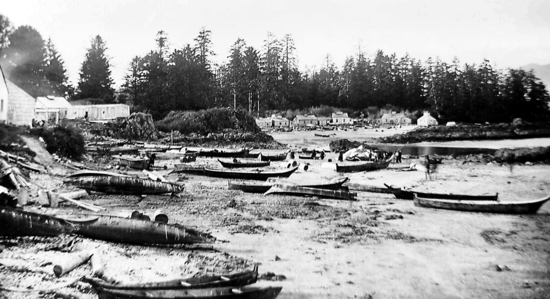
In 1869 Hesquiaht village and its people fell victim to one of the most appalling “tragedies of Victorian attitudes and relations between European and Aboriginal peoples.”139 In February of that year, the sailing barque John Bright foundered on the rocks off Hesquiaht Peninsula near Estevan Point in a vicious winter storm. Eleven people were on board, including the captain’s wife and children. No one survived. Enormous waves pounded the ship to pieces, and the bodies of the crew and passengers became horribly mutilated by the constant battering of the surf and rocks. News of the tragedy did not reach Victoria until early March, when sealing captain James Christensen arrived relating a sensational story to local newspapers. He reported seeing local Hesquiaht wearing victims’ clothing and jewellery, prompting the newspapers to speculate that the victims had “all undeniably found a watery grave, or have fallen by the hands of the West Coast savages.” The stories continued to speculate on what might have happened: that the captain had been shot while running away from “the cruel savages”; that “prisoners had been thrown down and their heads removed while they piteously begged for mercy” and that the children’s nursemaid, Beatrice Holden, had been “delivered up to the young men of the tribe, dragged into the bush where her cries filled the air for hours.”140
Eventually, in May 1870, Governor Frederick Seymour sent the steam-driven warship HMSSparrowhawk north from Victoria to investigate. After examining the remains of the exhumed bodies of the John Bright, the Sparrowhawk’s surgeon attested he could find no medical evidence indicating that the bodies had been decapitated by human hands, and that the gnawing of animals and the pounding of the bodies in the surf and on the rocks accounted for their mutilated condition.
Nevertheless, after the Hesquiaht chiefs refused to turn over the men who stood accused of these crimes, the Royal Marines set fire to the village houses and the ship’s cannons destroyed the canoes on the beach. The captain then ordered seven Hesquiaht men seized and taken to Victoria to be tried.
Following two separate trials, each deeply flawed, with a questionable interpreter, and each reported in hysterical language by the Victoria newspapers, an all-white jury of twenty men found two of the accused, Katkinna and John Anietsachist, guilty of murder. The judge sentenced them to be hanged. Taken back to Hesquiaht in chains aboard the Sparrowhawk, the two condemned men, along with their Hesquiaht brethren, stood by as carpenters erected a gallows on the beach. With the whole Hesquiaht tribe forced to watch, the two were hanged, as cannons boomed out over the harbour.
In 1875, eleven years after this tragedy, the Belgian Roman Catholic missionary Father Augustin Brabant arrived at the village, determined Hesquiaht would be the centre of his west coast mission. Here he erected the first church in Clayoquot Sound, St. Antonine, an imposing wooden structure that later burned down, to be rebuilt in 1891.
Brabant would live among the Hesquiaht for thirty-seven years, remaining there until ill health forced him to leave in 1912. He oversaw the construction of Catholic churches in several locations on the west coast, and was responsible for raising funds to start Christie School, at Kakawis. During Brabant’s first year at Hesquiaht, he survived an attack by one of the chiefs, nearly dying of his injuries, but he never faltered in his determination to convert the people he thought of as “his Indians.” Tall and powerfully built, Brabant brooked no opposition, establishing himself as a towering force to be reckoned with, up and down the west coast.
Shortly after Brabant died, a very different, but equally memorable, character entered the scene at Hesquiaht Harbour. In 1915 the indomitable Ada Annie Rae-Arthur disembarked from the Princess Maquinna into a waiting canoe at Hesquiaht village. With her, her husband Willie Rae-Arthur, their three children and little else barring the determination to homestead in the area on a pre-empted tract of land some 6 miles (almost 10 km) inside the harbour. Over time she established a highly productive garden there, at the eastern end of the harbour in Boat Basin. Later dubbed “Cougar Annie” because of her prowess in killing cougars, Ada Annie raised eight children, operated a general store and post office, and ran a mail-order nursery business. From the five-acre garden she created in the wilderness, she mailed plants and bulbs to customers as far away as Winnipeg. Her children and her first husband Willie would row the 6 miles (nearly 10 km) across to Hesquiaht to deliver her packages for shipment on the Princess Maquinna and collect supplies. On one of these journeys Willie drowned, on July 14, 1936. Later, one of her children, Laurie, also drowned in the harbour. Cougar Annie remained at Boat Basin for some seventy years, outlasting a total of four husbands. She died in 1987 at the age of 97.
On this trip up the coast it is clear that because of the exposed beach fronting the village, landing and loading goods at Hesquiaht always means a “boat landing” for the Maquinna. Canoes come out from the village and supplies are unloaded from the side doors of the steamer, while passengers struggle down the rope ladder extended to the vessels below. Off-loading cows for the mission can be particularly tricky. “Shorty” Wright would winch the unhappy creatures up in a sling and lower them into the water, and they would swim to the beach. If there were calves, crewmen would tie their feet and then ease them into the canoes to be carried ashore. In short order, about fifteen minutes after arriving here, the cargo doors close, the ship’s whistle sounds and the Maquinna sets off once again.
As the Maquinna rounds Hesquiaht Peninsula, her passengers can see the distinctive Estevan Point Lighthouse, set in a small bay called the Hole-in-the-Wall. Building began in 1908 and ended in 1910. At 98 ft (30 m) tall it is one of the largest free-standing concrete structures on the west coast, featuring eight flying buttresses anchoring it to the rocks against the blasts of storms and tremors of earthquakes. Early in World War II it would gain national and international attention, having apparently been shelled by a Japanese submarine.
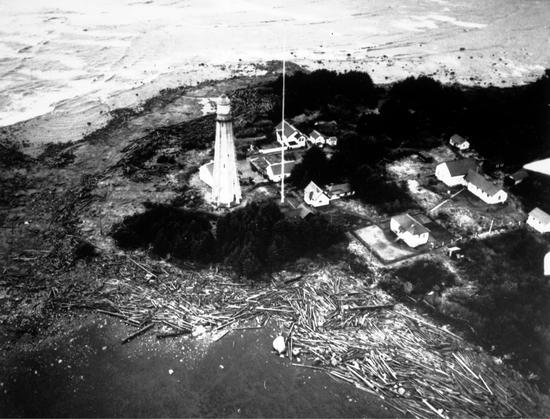
Prior to launching its surprise attack on US forces at Pearl Harbor, Hawaii, on December 7, 1941, the Japanese navy sent six submarines across the Pacific to attack shipping and shore installations on the coast of North America, aiming to create panic and fear among the citizens of the West Coast. One attacked a ship off California, killing five crew members, and later fired shells from its deck gun at an oil complex near Santa Barbara. The following summer, on June 20, 1942, Estevan Point Lighthouse received twenty-five incoming 5.5-inch shells purportedly fired by a Japanese submarine. Pan demonium erupted at the light station and among the Hesquiaht villagers. More recently there has been some skepticism about whether a Japanese submarine did indeed fire the shells, but the Japanese captain, who survived the war, admitted to the attack, and when questioned, survivors of a Japanese submarine that was sunk a year after the incident, in New Zealand, “admitted that they were responsible for the attack.”141
Skeptics believe the shelling was a false-flag operation from Allied sources attempting to convince the Canadian public of the danger facing its virtually undefended coast, and hoping to counter the reluctance of anti-conscription Quebecers to become involved in the war. Whatever the cause, the shelling of Estevan Point Lighthouse certainly caused panic, fuelling the controversial decision by the Canadian government to intern all of the 23,000 Japanese living in Canada, mostly along Canada’s west coast.
In 1924 all of this turmoil lies in the future, as the Maquinna heads across open waters for Yuquot, or Friendly Cove. Here the Good Ship enters the territory of the people from whom she derived her name—Princess Maquinna being the daughter of the most famous and powerful chief on the west coast, Chief Maquinna of the Mowachaht people.