
- About KnowBC
- Terms of Use
- Searching KnowBC
- BC Facts
- Books about BC
- BC Links
- For Teachers
- Connect to KnowBC FAQ


Cases of Mistaken Identity
“Truth is uniform and narrow,” wrote Benjamin Franklin. “But error is endlessly diversified.... In this field the soul has room enough to expand herself, to display all her boundless faculties, and all her beautiful and interesting extravagancies and absurdities.” So it is, certainly, with geographical place names. Mistakes in translating and transcribing names; errors in hearing, attributing and understanding names; spelling and punctuation mistakes—all have subtly distinguished our coastal heritage.
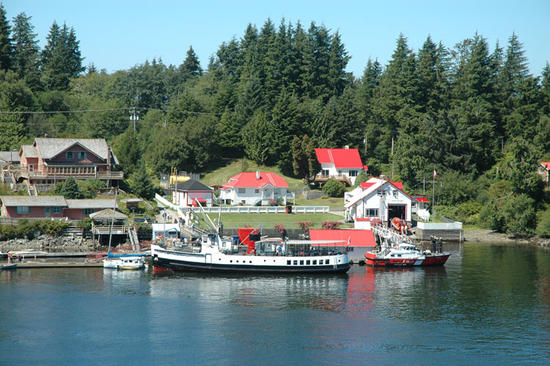
The range and quantity of errors is quite amazing. Some are mundane but still manage to leave a distinct impression in the fabric of coastal history. The west coast hamlet of Bamfield, for example, was named after early trader William Banfield, first white settler at Barkley Sound. A post office was established in 1903 with cancelling equipment that read “Bamfield” and was never corrected. The hydrographic service kept the name Banfield Inlet alive on charts until 1951, when all attempts to hang on to the true spelling of a historical name were abandoned and the feature officially became Bamfield Inlet. Dozens of other BC place names have suffered similar minor mishaps.
By contrast, there are names such as Caulfeild in West Vancouver, commemorating British land developer Francis Caulfeild, which appear to be misspelled but are, in fact, accurate. No doubt many attempts have been made over the years to “correct” this odd, old-fashioned name.
Numerous coastal names show the effect of what we might call “variable” spelling. Writers in the past did not have the same fixation on exact spelling that we do and were often quite content to spell the same word differently—even in the same sentence. Mackenzie Sound, for instance, north of Kingcome Inlet, is named for Kenneth McKenzie, bailiff of Craigflower Farm in the 1850s. Either spelling suited him. Corporal James Duffy of the Royal Engineers also spelled his name Duffey. Thus Duffy Rock and Duffey Lake both refer to the same person. Hudson’s Bay Company official John Wark got listed by mistake on company records as John Work and decided to just stick with the new name rather than face the bureaucratic nightmare of trying to get it changed back. Five coastal features named Blackney all refer to Royal Navy paymaster William Blakeney, who altered his name for reasons unknown after serving on the BC coast in the 1860s. A long list of comparable examples could be drawn up.
Early chart-makers had a difficult time with names from unfamiliar languages. The Ballenas Islands in the Strait of Georgia, christened with the Spanish word for whales, were shown on charts for many years as “Ballinac.” Gabriola Island is a misnomer. The actual name, applied by Spanish navigators in the early 1790s, was Gaviola, which may refer to a 17th-century Spanish naval officer. Gaviola was sometimes written Gabiola (which is pronounced similarly in Spanish), and a British cartographer managed to slip in an errant “r,” probably in the mid-1800s. Now we’re stuck with Gabriola. (The same cartographer also misspelled the name Porlier, with the result that Portier Pass appeared on Gulf Island charts for half a century until changed back to its original form.)
Historians make mistakes as well. Henry Wagner, the foremost authority on 19th-century Pacific Northwest map-making, known for his scrupulous accuracy, was nevertheless convinced that José Narváez, first Spanish explorer to see Gabriola, named the island’s eastern point Gaviota, Spanish for seagull. But there is no documentary evidence for this claim whatsoever.
First Nation terms, naturally, bedevilled pioneer cartographers. All kinds of huge mistakes were made over them. The name of Nootka Sound itself, the main site of early contact and exchange between European and First Nation cultures, is the most famous booboo. Captain James Cook reported in 1778 that the inlet was named Nootka by its inhabitants. But what he probably heard when asking, no doubt with many hand gestures, for the name of the place was advice on where to anchor his vessels: nootka-a, meaning “go around.” This minor mix-up resulted in one of our most significant place names.
No doubt there are other mysterious naming blunders out there on the coast waiting to be unravelled and put to rights.